
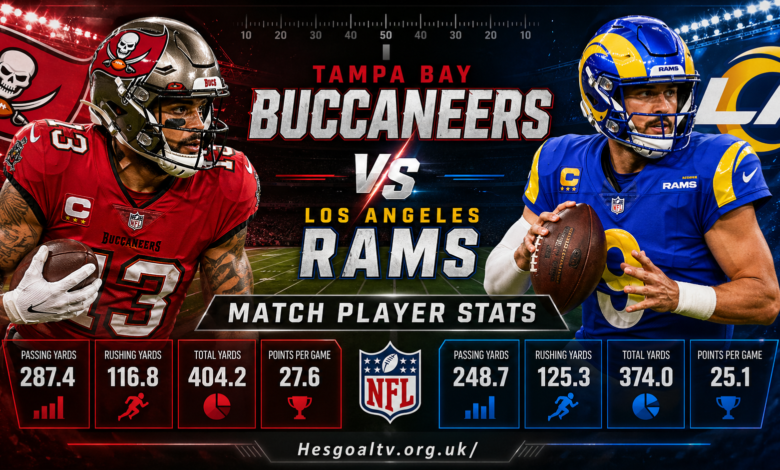
The matchup between the Tampa Bay Buccaneers and the Los Angeles Rams delivered one of the clearest statistical stories of the 2025 NFL season. The Rams controlled the game from the opening quarter, built a commanding first-half lead, and finished with a 34-7 win at SoFi Stadium on November 23, 2025. For fans, analysts, fantasy managers, and bettors, the Tampa Bay Buccaneers vs Los Angeles Rams Match Player Stats show how one team dominated with passing efficiency, defensive pressure, and mistake-free execution.
This game was not only about the final score. The box score explains why the Rams looked sharper in nearly every important phase. Matthew Stafford played with confidence, Davante Adams remained a red-zone weapon, Puka Nacua moved the chains, and the Rams defense punished Tampa Bay’s passing game. On the other side, the Buccaneers struggled to protect the quarterback, create explosive plays, and sustain drives against a fast, aggressive Los Angeles defense.
Match Overview
The Los Angeles Rams defeated the Tampa Bay Buccaneers 34-7 in a Week 12 matchup that became one-sided very early. Los Angeles scored on its opening drive and then added defensive points through Cobie Durant’s interception return. By halftime, the Rams had already created a 31-7 advantage, leaving Tampa Bay with very little room for a comeback. The official Buccaneers recap also described the Rams as coming out “firing on all cylinders,” which accurately reflects the tone of the game.
The Buccaneers entered the game needing offensive balance, but they could not build consistent rhythm. Baker Mayfield threw for only 41 yards before leaving the game at halftime, while Teddy Bridgewater finished with 62 passing yards in relief. Tampa Bay did produce 123 rushing yards as a team, but those numbers did not translate into scoring pressure because the passing game failed to stretch the Rams defense.
Tampa Bay Buccaneers vs Los Angeles Rams Match Player Stats Overview
The Tampa Bay Buccaneers vs Los Angeles Rams Match Player Stats reveal a game shaped by quarterback efficiency, defensive disruption, and field-position control. Matthew Stafford completed 25 of 35 passes for 273 yards, three touchdowns, and no interceptions. That clean passing line gave the Rams control of tempo and allowed them to attack Tampa Bay without needing a huge rushing performance.
Tampa Bay’s quarterback numbers were the opposite. Baker Mayfield completed 9 of 19 passes for 41 yards, one touchdown, and two interceptions. Teddy Bridgewater completed 8 of 15 passes for 62 yards with no touchdowns and no interceptions. Combined, the Buccaneers passing attack produced only 103 receiving yards, which made it difficult to challenge the Rams vertically or keep drives alive on third down.
Complete Box Score Story
The box score tells the story of a fast Rams start and a Buccaneers offense that never fully recovered. Los Angeles led 21-0 early in the second quarter after Stafford found Davante Adams, Cobie Durant returned an interception for a touchdown, and Stafford later connected with Colby Parkinson. A second Stafford-to-Adams touchdown and a Harrison Mevis field goal pushed the Rams ahead 31-7 before halftime.
The final score of 34-7 reflected more than scoring efficiency. It showed Los Angeles winning the important moments that decide NFL games. The Rams finished drives, protected the football, pressured the quarterback, and turned turnovers into points. Tampa Bay moved the ball occasionally on the ground, but its inability to create passing production or avoid interceptions made the game increasingly difficult after the first quarter.
Los Angeles Rams Passing Performance
Matthew Stafford was the most important offensive player in this game. His final line of 25 completions on 35 attempts for 273 yards, three touchdowns, and no interceptions showed veteran control. Stafford did not simply collect yards after the Rams had already built a lead; he created the lead with accurate early throws, smart reads, and strong red-zone decisions.
The most impressive part of Stafford’s performance was his efficiency under game pressure. He completed passes to multiple targets, avoided risky throws, and kept the offense ahead of schedule. The Rams did not need to chase big plays on every snap because Stafford repeatedly found the right matchup. His connection with Adams near the goal line gave Los Angeles a clear finishing advantage.
Los Angeles Rams Receiving Stats
Davante Adams delivered the headline receiving performance for Los Angeles. He finished with five catches for 62 yards and two touchdowns, becoming the biggest scoring threat in the Rams passing attack. His two touchdown receptions were especially important because they helped Los Angeles turn early drives into a comfortable lead rather than settling for field goals.
Puka Nacua also played a major role even though Adams took the scoring spotlight. Nacua recorded seven catches for 97 yards, giving Stafford a reliable chain-moving option throughout the game. His route running and ability to create separation helped Los Angeles extend drives and attack Tampa Bay’s coverage structure. Together, Adams and Nacua gave the Rams both scoring power and possession control.
Los Angeles Rams Rushing Stats
The Rams did not dominate through the running game, but they used it well enough to maintain balance. Kyren Williams carried the ball 12 times for 46 yards, while Blake Corum added 24 yards on seven attempts. As a team, Los Angeles rushed for 70 yards, which was not explosive but remained useful in protecting the lead and keeping Tampa Bay’s defense honest.
This rushing output matters because the Rams did not need a huge ground game to win. Their passing attack and defensive scoring had already placed Tampa Bay under pressure. Once the Rams led by multiple possessions, modest rushing gains became valuable because they drained clock, reduced risk, and allowed the offense to manage the second half without forcing unnecessary throws.
Los Angeles Rams Defensive Performance
The Rams defense was outstanding, and its impact cannot be measured only by yards allowed. Los Angeles forced interceptions, pressured the quarterback, and limited Tampa Bay’s ability to generate explosive passing plays. Cobie Durant’s interception return for a touchdown was one of the defining moments because it turned defensive pressure into immediate points and pushed the Buccaneers into chase mode.
Kobie Turner also stood out with six total tackles and two sacks, according to the Buccaneers’ official recap. Jared Verse also recorded two sacks, giving the Rams a strong pass-rushing presence throughout the game. When a defense creates sacks, interceptions, and scoring plays in the same matchup, it usually controls the emotional direction of the contest.
Tampa Bay Buccaneers Passing Performance
For Tampa Bay, the passing numbers were the biggest weakness. Baker Mayfield completed only 9 of 19 passes for 41 yards, one touchdown, and two interceptions. Those numbers show how difficult it was for the Buccaneers to find rhythm against the Rams defense. The short average gain also reflected the lack of successful downfield passing.
Teddy Bridgewater entered the game after Mayfield left at halftime with a shoulder injury. Bridgewater completed 8 of 15 passes for 62 yards, but he could not change the momentum. Tampa Bay’s combined passing production was too limited to threaten a comeback. When a team trails by 24 points at halftime, it needs explosive passing plays, and the Buccaneers could not produce them.
Tampa Bay Buccaneers Rushing Stats
The Buccaneers had some positive signs on the ground despite the heavy defeat. Sean Tucker led Tampa Bay with 42 rushing yards on 12 carries, while Rachaad White added 38 yards on seven carries. White averaged 5.4 yards per carry, showing that Tampa Bay had moments of rushing efficiency when it found space.
However, the rushing success did not change the scoreboard because Tampa Bay was forced into a difficult game script. Once the Rams built a large early lead, the Buccaneers needed more from the passing game. Running the ball can stabilize an offense, but it cannot easily erase a 31-7 halftime deficit without major help from explosive plays or defensive takeaways.
Tampa Bay Buccaneers Receiving Stats
Tez Johnson produced Tampa Bay’s only receiving touchdown and finished with three catches for 21 yards. Emeka Egbuka had three receptions for 32 yards, including Tampa Bay’s longest receiving gain of the game. Cade Otton caught four passes for 21 yards, giving the Buccaneers a short-area option but not enough field-stretching production.
The receiving stats show how well the Rams controlled Tampa Bay’s passing lanes. No Buccaneers receiver reached 40 receiving yards, and the offense averaged only 6.1 yards per reception as a team. That lack of explosive production made every drive feel difficult. Tampa Bay needed receivers to win deeper routes, but Los Angeles forced the offense into short, contained gains.
Team Stats Comparison
The team stats strongly favor the Rams in overall impact. Los Angeles finished with 333 total net yards, while Tampa Bay had 193 total net yards according to the Rams’ official box score page. That 140-yard gap was important, but the bigger difference came from scoring efficiency and turnovers. The Rams turned their yards into touchdowns, while Tampa Bay struggled to convert movement into points.
Tampa Bay did outrush Los Angeles 123 to 70, but that statistic does not fully reflect control of the game. The Rams dominated through passing efficiency, defensive points, sacks, and interceptions. This is why box score analysis must go beyond one category. The Buccaneers had rushing production, but the Rams controlled the scoreboard, passing game, and momentum.
Major Turning Points
The first major turning point came when the Rams finished their opening drive with a touchdown. That early score placed immediate pressure on Tampa Bay and allowed Los Angeles to play aggressively on defense. Soon after, Cobie Durant’s 50-yard interception return made the game feel completely different, turning a competitive matchup into a 14-point Rams advantage.
Another major moment came when Stafford connected with Colby Parkinson for a touchdown and then later found Adams again. Those plays pushed Los Angeles into full control before halftime. Tampa Bay’s failed attempts to answer consistently made the gap wider. By the time the Rams entered halftime up 31-7, the game had already developed a clear statistical and emotional direction.
Offensive Analysis
The Rams offense succeeded because it played with rhythm and purpose. Stafford distributed the ball efficiently, Adams finished drives, and Nacua gave the offense a reliable possession target. The Rams did not need to depend on trick plays or desperate deep shots because their structure was strong. They created manageable downs and punished Tampa Bay when coverage weakened.
Tampa Bay’s offense looked disconnected by comparison. The running game produced some useful gains, but the passing attack was too limited to support a comeback. Mayfield’s interceptions hurt field position and momentum, while Bridgewater’s second-half work came when the game was already heavily tilted. The Buccaneers needed balance, but they received only partial production from one phase.
Defensive Analysis
Los Angeles won defensively by attacking Tampa Bay’s weaknesses. The Rams pressured the quarterback, forced quick throws, and prevented receivers from turning short catches into major gains. The interceptions were especially damaging because they did not simply stop drives; they created scoring opportunities and changed the pace of the game. That is exactly what elite defenses do in high-control wins.
Tampa Bay’s defense had some respectable moments, especially against the run, where it held the Rams to 70 rushing yards. However, the Buccaneers struggled to contain Stafford’s passing rhythm and could not stop the Rams from scoring early. When a defense allows three touchdown passes and an opponent builds a 31-point first half, strong rushing defense becomes less meaningful.
Head-to-Head Context
The Buccaneers and Rams have played several meaningful games over the years, and their matchups often attract attention because both franchises have had strong postseason identities. This particular meeting added another clear result to their history, with Los Angeles delivering a dominant regular-season performance. Sports-Reference and Pro Football Reference both track the broader team and box score history of this matchup.
This game stands out because it was not close in the second half. Some Buccaneers-Rams meetings have been remembered for late drama, playoff tension, or quarterback battles. This one was remembered for the Rams’ early control, Stafford’s clean execution, Adams’ scoring impact, and a defense that turned Tampa Bay mistakes into points.
What the Stats Reveal About the Rams
The Tampa Bay Buccaneers vs Los Angeles Rams Match Player Stats reveal that Los Angeles had the profile of a complete team in this matchup. The Rams passed efficiently, protected the football, scored early, and created defensive pressure. Stafford’s no-interception performance was especially important because it allowed the Rams to build a lead without giving Tampa Bay short-field opportunities.
The stats also show that the Rams did not need perfection in every category. Their rushing total was modest, but their passing production and defense carried the night. This type of win is encouraging because it shows multiple winning paths. When a team can score through the air and also generate defensive touchdowns, it becomes extremely difficult to beat.
What the Stats Reveal About the Buccaneers
For Tampa Bay, the numbers reveal a team that could not overcome passing-game failure. The Buccaneers ran for more than 100 yards, but their quarterbacks combined for limited production through the air. Mayfield’s two interceptions and low yardage total placed the defense under extra pressure and reduced the offense’s ability to stay competitive.
There were still some positives. Sean Tucker and Rachaad White gave the Buccaneers useful rushing production, and Tez Johnson scored the team’s only touchdown. However, the larger lesson is clear. Tampa Bay needed more protection, better downfield passing, and fewer turnovers. Without those improvements, even a good rushing day can disappear inside a lopsided final score.
Key Performers of the Match
Matthew Stafford was the best overall offensive performer. His three touchdown passes, 273 passing yards, and zero interceptions gave the Rams stability and scoring power. He controlled the game early, found his best weapons, and avoided the mistake that could have allowed Tampa Bay to recover. His performance was the foundation of the Rams’ offensive success.
Davante Adams was the most decisive receiving performer because of his two touchdowns. Puka Nacua was also highly valuable with seven catches for 97 yards. Defensively, Cobie Durant’s interception return and Kobie Turner’s two-sack performance gave Los Angeles game-changing production. For Tampa Bay, Sean Tucker, Rachaad White, and Tez Johnson were among the few statistical bright spots.
Fantasy Football Takeaways
Fantasy managers who started Stafford, Adams, or Nacua benefited from the Rams’ offensive rhythm. Stafford delivered touchdown volume without interceptions, Adams produced two scores, and Nacua gave strong reception and yardage value. In fantasy terms, this was the type of game where concentrated production made the Rams’ top passing options especially useful.
Tampa Bay fantasy options were more disappointing. Tez Johnson’s touchdown helped, but no Buccaneers receiver produced major yardage. The running backs had decent rushing totals, yet the game script limited their ceiling. When a team trails by a large margin, fantasy managers usually need receiving volume from backs and receivers, but Tampa Bay could not create enough offensive rhythm.
Betting and Prediction Takeaways
From a betting perspective, this game showed why matchup details matter more than surface-level team reputation. The Rams’ pass rush, Stafford’s form, and Adams’ red-zone role all became decisive factors. Anyone studying the Tampa Bay Buccaneers vs Los Angeles Rams Match Player Stats after the game would see that Los Angeles had advantages in the categories most connected to winning.
The final score also reminds bettors that rushing yards alone do not guarantee competitiveness. Tampa Bay outrushed Los Angeles, but turnovers, passing efficiency, sacks, and first-half scoring mattered more. Future predictions involving these teams should consider quarterback health, offensive line protection, and defensive pressure rates before relying only on basic team records or recent scores.
Final Match Takeaways
The Rams deserved the 34-7 win because they were better in the most important areas. They started fast, protected the ball, pressured the quarterback, and turned defensive plays into points. Stafford and Adams delivered the scoring punch, while Nacua and the defense helped maintain control. The result felt decisive because Los Angeles never allowed Tampa Bay to reset the game.
For the Buccaneers, the loss exposed several concerns. Their passing attack lacked rhythm, turnovers damaged momentum, and the defense could not prevent early Rams touchdowns. The rushing game was one positive area, but it was not enough to overcome the passing struggles. Tampa Bay needed a cleaner and more explosive offensive performance to stay close.
Conclusion
The Tampa Bay Buccaneers vs Los Angeles Rams Match Player Stats provide a complete explanation of why Los Angeles won so comfortably. Stafford’s efficient passing, Adams’ touchdown production, Nacua’s receiving volume, and the Rams’ defensive pressure created a complete team performance. The box score did not hide the truth; it confirmed the Rams were sharper, faster, and more clinical.
For Tampa Bay, the game became a lesson in how quickly turnovers and passing struggles can destroy a matchup. The Buccaneers had some rushing success, but they lacked the balance needed to challenge a confident Rams team. In the end, the box score, player stats, and final score all point toward one conclusion: Los Angeles controlled the game from start to finish.
FAQs
What was the final score of Tampa Bay Buccaneers vs Los Angeles Rams?
The Los Angeles Rams defeated the Tampa Bay Buccaneers 34-7 on November 23, 2025, at SoFi Stadium. The Rams built a huge first-half lead and controlled the rest of the game through efficient passing, defensive pressure, and strong red-zone execution.
Who was the top performer in the game?
Matthew Stafford was the top overall performer because he completed 25 of 35 passes for 273 yards, three touchdowns, and no interceptions. Davante Adams was also a major standout with five receptions for 62 yards and two touchdowns.
How did Baker Mayfield perform against the Rams?
Baker Mayfield struggled against the Rams defense. He completed 9 of 19 passes for 41 yards, one touchdown, and two interceptions before leaving the game at halftime with a shoulder injury. His turnovers and low passing yardage made Tampa Bay’s comeback chances very difficult.
Which Rams receiver had the best stats?
Puka Nacua led the Rams in receiving yards with seven catches for 97 yards, while Davante Adams had the biggest scoring impact with five catches, 62 yards, and two touchdowns. Both receivers played important roles in the Rams’ offensive dominance.
How did the Buccaneers running game perform?
The Buccaneers had decent rushing production despite the loss. Sean Tucker rushed 12 times for 42 yards, while Rachaad White added 38 yards on seven carries. Tampa Bay finished with 123 rushing yards, but the ground game could not overcome the team’s passing struggles.
Why did the Rams win so comfortably?
The Rams won comfortably because they scored early, protected the football, forced turnovers, and pressured Tampa Bay’s quarterbacks. Stafford’s passing efficiency and the defense’s ability to create points gave Los Angeles control before halftime. Tampa Bay never found enough offensive rhythm to respond.
What was the biggest turning point of the game?
Cobie Durant’s 50-yard interception return for a touchdown was one of the biggest turning points. It gave the Rams a two-score lead early and changed the pressure of the game. After that moment, Tampa Bay was forced to chase the scoreboard against an aggressive Rams defense.
What do the stats say about the Rams defense?
The stats show that the Rams defense was one of the biggest reasons for the win. Los Angeles forced interceptions, created sacks, scored a defensive touchdown, and held Tampa Bay’s passing attack to limited production. Kobie Turner and Jared Verse both made major pass-rushing contributions.
Why are player stats important in this matchup?
Player stats are important because they explain the real reason behind the final score. The Tampa Bay Buccaneers vs Los Angeles Rams Match Player Stats show that quarterback efficiency, turnovers, receiving production, and defensive pressure mattered more than simple rushing totals or possession numbers.
Where can fans find the full Buccaneers vs Rams box score?
Fans can find the full box score on major sports sites such as ESPN, NFL.com, Pro Football Reference, and the official Los Angeles Rams website. These sources include passing, rushing, receiving, defensive, scoring, and team statistics from the matchup.