
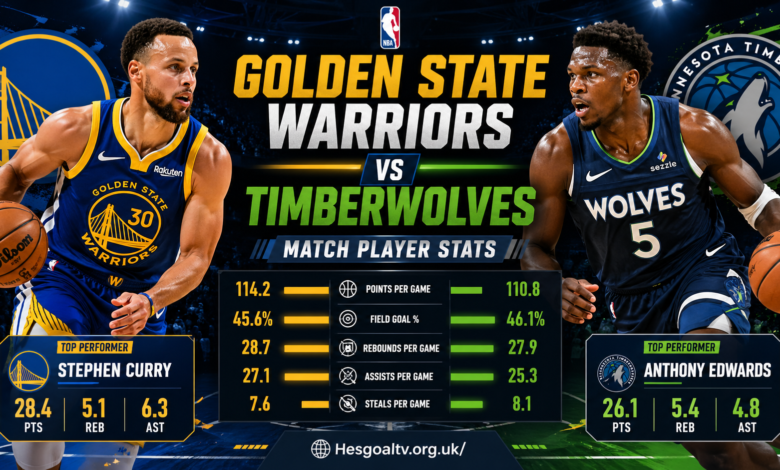
Golden State Warriors vs Timberwolves Match Player Stats: Box Score and Game Leaders

Introduction
The Golden State Warriors and Minnesota Timberwolves have become one of the most interesting Western Conference matchups because both teams bring different basketball identities to the court. Golden State is known for spacing, quick ball movement, perimeter shooting, and experienced leadership, while Minnesota often relies on size, physical defense, rebounding, and strong interior presence. This contrast makes every meeting rich in tactical details and player performance storylines.
When fans search for Golden State Warriors vs Timberwolves Match Player Stats, they usually want more than a final score. They want to know who scored the most points, who controlled the glass, which player created assists, how both teams shot from the field, and which role players changed the flow of the game. Recent meetings have included both a Warriors 111-85 win on January 25, 2026 and a Timberwolves 127-120 win on December 12, 2025, giving fans plenty of data to analyze.
Golden State Warriors vs Timberwolves Match Overview
A Warriors vs Timberwolves game is rarely just about one superstar. It is usually a battle between systems, matchups, and momentum swings. Golden State tries to stretch the floor with shooters, force defensive rotations, and create open looks through off-ball movement. Minnesota, on the other hand, often looks to slow down the rhythm, protect the paint, win rebounds, and use its size advantage to control important possessions.
In the January 25, 2026 meeting, Golden State defeated Minnesota 111-85, with Stephen Curry scoring 26 points and the Warriors using a major third-quarter push to separate from the Timberwolves. In the December 12, 2025 meeting, Minnesota answered in a very different style, beating Golden State 127-120 behind strong scoring, rebounding, and late-game execution. These results show why the box score is so important: each game tells a different story.
Complete Box Score Summary
The complete box score is the foundation of every serious game analysis because it explains how the result happened. Points show scoring output, but field goal percentage, three-point percentage, rebounds, assists, turnovers, steals, and blocks show the deeper reasons behind the final score. A team can lose despite having a star scorer if it struggles with turnovers, bench production, rebounding, or late defensive execution.
For Golden State Warriors vs Timberwolves Match Player Stats, the box score should be read in layers. First, check the final score and quarter-by-quarter scoring. Then examine shooting efficiency, especially from three-point range. After that, look at rebounds, assists, turnovers, and points in the paint. These categories reveal whether the game was controlled by shooting, physicality, fast breaks, defense, or late-game decision-making.
Golden State Warriors Player Stats
Golden State’s player stats usually begin with Stephen Curry because his scoring, spacing, and shooting gravity affect every part of the Warriors’ offense. Even when Curry is not taking every shot, defenders chase him through screens, which opens passing lanes for teammates. His points, assists, three-point shooting, and plus-minus are always important indicators of how smoothly Golden State’s offense operated during the game.
However, the Warriors cannot rely on Curry alone. The best Golden State performances usually include strong support from role players, wings, and bench scorers. Players who hit open threes, defend multiple positions, rebound well, and keep the ball moving are essential. In matchups against Minnesota’s size, Golden State also needs physical contributions from its forwards and centers to avoid losing the paint and rebounding battle.
Minnesota Timberwolves Player Stats
Minnesota’s player stats often show a more physical style of basketball. The Timberwolves usually look for production from their frontcourt, rim protectors, and versatile wings. Rebounds, blocks, paint points, and defensive impact are especially important when analyzing their performance against Golden State. If Minnesota controls the interior and limits second-chance opportunities, it can make the Warriors uncomfortable on both ends.
In the December 12, 2025 Timberwolves win, Rudy Gobert recorded 24 points and 14 rebounds, while Julius Randle added major scoring impact and Donte DiVincenzo made clutch plays late in the game. Minnesota’s ability to score inside, rebound, and execute late helped it overcome Stephen Curry’s 39-point performance. That game is a strong example of how balanced team stats can beat individual brilliance.
Game Leaders in Points, Rebounds and Assists
Game leaders are important because they quickly show which players shaped the contest. The top scorer often gets the headline, but the leading rebounder and assist leader can be just as important. In Warriors vs Timberwolves games, scoring leaders may come from perimeter stars, while rebounding leaders often come from Minnesota’s frontcourt or Golden State players fighting to balance the physical gap.
For Golden State Warriors vs Timberwolves Match Player Stats, points should never be viewed alone. A player who scores 25 points on efficient shooting may be more valuable than someone who scores 30 points with poor shot selection. Similarly, a player with 10 assists and low turnovers can control the rhythm of the game, while a dominant rebounder can reduce the opponent’s second-chance points and create extra possessions.
Shooting Performance and Efficiency
Shooting efficiency is one of the most important factors in this matchup because Golden State depends heavily on spacing and perimeter rhythm. When the Warriors shoot well from three-point range, they can quickly turn a close game into a double-digit lead. Their offense becomes harder to guard because defenders must chase shooters, switch screens, and protect against backdoor cuts at the same time.
Minnesota’s shooting efficiency matters in a different way. The Timberwolves can win by combining paint scoring with timely three-point shots. In the December 12, 2025 game, ESPN’s team stats showed Minnesota shooting 54% from the field compared with Golden State’s 46%, while the Timberwolves also had a strong advantage in points in the paint. That kind of efficiency explains why Minnesota survived Golden State’s three-point pressure.
Rebounds and Paint Battle
Rebounding is often the hidden battle in Warriors vs Timberwolves games. Golden State wants to finish defensive possessions quickly and get into transition, while Minnesota wants to use size and strength to create extra chances. Offensive rebounds can completely change momentum because they punish good defensive possessions and often lead to open threes, fouls, or easy baskets near the rim.
The paint battle is equally important. If Minnesota dominates inside, Golden State has to collapse defensively, which can open space for shooters. If the Warriors keep Minnesota away from easy paint points, they can force more difficult jump shots and speed up the game. The team that controls rebounds and paint touches usually controls the emotional rhythm, even when the scoreboard remains close.
Assists, Ball Movement and Team Chemistry
Assists reveal how well a team is sharing the ball and creating quality shots. Golden State’s best offensive possessions usually involve multiple passes, screens, cuts, and quick decisions. Their system works best when the ball does not stick in one player’s hands. When the Warriors create open threes and layups through movement, their assist numbers usually rise and their offense becomes much harder to defend.
Minnesota’s assists often show how well its stars and big men are connecting with teammates. A strong assist total means the Timberwolves are not relying only on isolation plays or difficult contested shots. In the December 2025 matchup, Minnesota finished with 30 assists compared with Golden State’s 27, showing that the Timberwolves generated efficient looks through team play rather than depending on one scorer alone.
Defensive Stats: Steals, Blocks and Turnovers
Defense is not always captured perfectly in the box score, but steals, blocks, turnovers, and opponent shooting percentage provide useful clues. A steal can lead directly to fast-break points, while a block can discourage drives to the basket. Turnovers are especially damaging against teams like Golden State because one mistake can quickly become a transition three or a momentum-changing scoring run.
Minnesota’s defensive strength often comes from length, rim protection, and physical matchups. Golden State’s defense depends more on communication, rotations, and forcing opponents into uncomfortable shots. In this matchup, the winning team usually limits live-ball turnovers and avoids giving the opponent easy transition opportunities. For Golden State Warriors vs Timberwolves Match Player Stats, turnovers are one of the most important categories to study closely.
Star Player Comparison
Star player comparison is one of the most searched parts of this matchup because fans want to know who performed better under pressure. Stephen Curry’s value comes from scoring, shooting range, gravity, and late-game shot-making. Even when he is double-teamed, his movement creates space for teammates. That is why his box score impact often goes beyond points and assists.
For Minnesota, star impact may come through scoring, rebounding, defense, or interior control. Players like Rudy Gobert, Julius Randle, Anthony Edwards when available, and other key contributors can influence the game in different ways. A Timberwolves star does not always need to outscore Curry to win the comparison. If Minnesota’s top players dominate the boards, protect the rim, and finish efficiently, they can have the greater overall impact.
Bench Performance and Role Players
Bench performance can decide Warriors vs Timberwolves games because both teams need reliable production beyond their starters. Golden State’s bench is especially important when Curry rests. If the second unit keeps the offense stable, avoids turnovers, and hits open shots, the Warriors can maintain leads. If the bench struggles, opponents often use those minutes to erase Golden State’s advantage.
Minnesota’s bench can change the game through energy, defense, rebounding, and timely shooting. A role player who scores 12 to 15 points efficiently can shift the outcome, especially in a close fourth quarter. Bench players also matter defensively because they must survive difficult minutes against elite shooters and physical frontcourt players. In this matchup, depth is often as important as star power.
Key Moments That Changed the Game
Every box score has a story, but key moments explain the emotion behind the numbers. A third-quarter scoring run, a late turnover, a clutch three-pointer, or a defensive stop can become the turning point. In the January 25, 2026 Warriors win, Golden State’s game-changing third quarter helped create separation and turned the contest into a comfortable victory.
In the December 12, 2025 Timberwolves win, Minnesota used late-game execution to overcome Curry’s scoring burst. Reports noted that the Timberwolves closed strongly, with Donte DiVincenzo hitting important shots and Minnesota taking advantage of Golden State’s late offensive drought. These turning points show why fans should read both the box score and the game recap to understand how the result was shaped.
Warriors vs Timberwolves Head-to-Head Trends
Head-to-head trends help readers understand whether a result is surprising or part of a larger pattern. The Warriors and Timberwolves have played many competitive games, and recent matchups have shown different styles of victory. Golden State can win through shooting, movement, and quick scoring bursts. Minnesota can win through size, interior scoring, rebounding, and defensive pressure.
For SEO readers, head-to-head context is useful because it connects one game to a broader rivalry. If Minnesota has recently controlled the boards against Golden State, that becomes a trend worth tracking. If Golden State has found success with pace and three-point shooting, that also matters. These patterns help fans predict what might happen in future meetings between the two teams.
What the Match Player Stats Reveal
The match player stats reveal more than individual numbers. They show team identity, coaching strategy, player roles, and pressure moments. If Golden State has high assist numbers and strong three-point shooting, it usually means the Warriors played their preferred style. If Minnesota has more rebounds, paint points, and free-throw attempts, it usually means the Timberwolves made the game more physical.
Golden State Warriors vs Timberwolves Match Player Stats also help explain why the same teams can produce very different results in separate games. One night, Curry’s shooting and Golden State’s spacing may decide everything. Another night, Minnesota’s frontcourt and late-game defense may control the outcome. That is why a complete player-stat breakdown is more useful than simply checking the final score.
Why Box Score Analysis Matters for Fans
Box score analysis helps casual fans understand the game more clearly and helps serious fans evaluate performance with more depth. A final score tells who won, but the box score explains how they won. It reveals whether the result came from shooting, defense, rebounds, turnovers, bench scoring, or free throws. This makes the game easier to discuss and compare.
For content readers, box score analysis also creates a complete picture of player value. A player may score fewer points but still dominate through defense, assists, and rebounds. Another player may score heavily but struggle with turnovers or poor efficiency. By reading all major categories together, fans can understand which players truly influenced the Golden State Warriors vs Timberwolves matchup.
Lessons for Golden State Warriors
For Golden State, the main lesson from this matchup is the importance of balance. The Warriors are dangerous when their stars score efficiently, but they become much stronger when role players contribute, the bench protects leads, and the team avoids careless turnovers. Their offense needs spacing and movement, but their defense must also survive against Minnesota’s physical frontcourt.
Another lesson is that three-point shooting alone is not always enough. Golden State can hit more threes and still lose if it gives up too many paint points, rebounds, or late-game runs. Against Minnesota, the Warriors need disciplined defensive rotations, stronger rebounding, and consistent scoring beyond Curry. Their best formula is not just shooting, but complete team execution.
Lessons for Minnesota Timberwolves
For Minnesota, the biggest lesson is that size and balance can disrupt Golden State’s rhythm. When the Timberwolves control the paint, rebound well, and move the ball effectively, they can force the Warriors into difficult situations. Their defense must stay alert because Golden State can erase leads quickly with three-point shooting and transition scoring.
Minnesota also needs smart late-game decision-making. Against experienced teams like Golden State, poor turnovers or missed defensive assignments can change the result within minutes. When the Timberwolves combine physical defense with efficient offense, they become a difficult matchup. Their best performances come when multiple players contribute rather than relying on one star to carry the entire scoring load.
Conclusion
The Golden State Warriors and Minnesota Timberwolves matchup continues to offer rich basketball analysis because both teams challenge each other in different ways. Golden State brings shooting, movement, experience, and star power, while Minnesota brings size, rebounding, defense, and interior strength. That contrast makes every box score meaningful for fans who want to understand the game beyond the final result.
Golden State Warriors vs Timberwolves Match Player Stats are important because they reveal the real story behind each meeting. Points, rebounds, assists, steals, blocks, turnovers, shooting percentages, bench scoring, and game leaders all help explain why one team won and the other fell short. Whether the game is decided by Curry’s shooting, Minnesota’s paint dominance, or a late defensive stop, the stats always tell the deeper story.
FAQs
Who was the top scorer in the Golden State Warriors vs Timberwolves match?
The top scorer depends on the specific game being analyzed. In the December 12, 2025 meeting, Stephen Curry scored 39 points for Golden State, but Minnesota still won 127-120. In other matchups, the leading scorer may come from either team depending on shooting rhythm, defensive matchups, injuries, and minutes played.
Which player had the most rebounds in the game?
The leading rebounder changes from game to game, but Minnesota often has a strong advantage in this category because of its frontcourt size. Rudy Gobert is regularly a major rebounding factor, and in the December 2025 matchup, he recorded 14 rebounds along with 24 points. Rebounding is one of the most important stats in this rivalry.
Who recorded the most assists in Warriors vs Timberwolves?
The assists leader depends on the flow of the game. Golden State often creates assists through ball movement, off-ball screens, and quick passing, while Minnesota can generate assists through inside-out play and strong frontcourt passing. The best assist performance usually belongs to the player who controls pace and creates efficient shots for teammates.
Where can fans check the full Warriors vs Timberwolves box score?
Fans can check the full box score on official and trusted sports platforms such as NBA.com, ESPN, Basketball-Reference, and official team websites. These sources usually provide points, rebounds, assists, steals, blocks, turnovers, shooting percentages, minutes played, team stats, play-by-play details, and sometimes video highlights or shot charts.
Why are player stats important in this matchup?
Player stats are important because they explain how each team performed beyond the final score. They show who scored efficiently, who controlled rebounds, who created assists, who defended well, and who struggled with turnovers. In a matchup like Warriors vs Timberwolves, stats help reveal whether shooting, size, defense, or bench depth decided the game.
Which team usually has the better three-point advantage?
Golden State is usually associated with three-point shooting because of its system and Stephen Curry’s historic shooting ability. However, Minnesota can compete from deep when its role players hit open looks. The three-point advantage depends on shot quality, defensive pressure, spacing, and whether either team gets hot during key stretches.
Did bench players make a difference in Warriors vs Timberwolves?
Yes, bench players can make a major difference in this matchup. Golden State needs bench scoring and ball security when its starters rest, while Minnesota needs energy, defense, rebounding, and timely shooting from its second unit. A strong bench performance can protect a lead, change momentum, and decide close games.
What is the biggest stat to watch in Golden State Warriors vs Timberwolves games?
The biggest stat to watch is often the combination of turnovers, rebounds, and shooting efficiency. Golden State needs clean possessions and strong three-point shooting, while Minnesota needs paint control and rebounding. When one team wins two or more of these major categories, it usually has a strong chance of winning the game.