

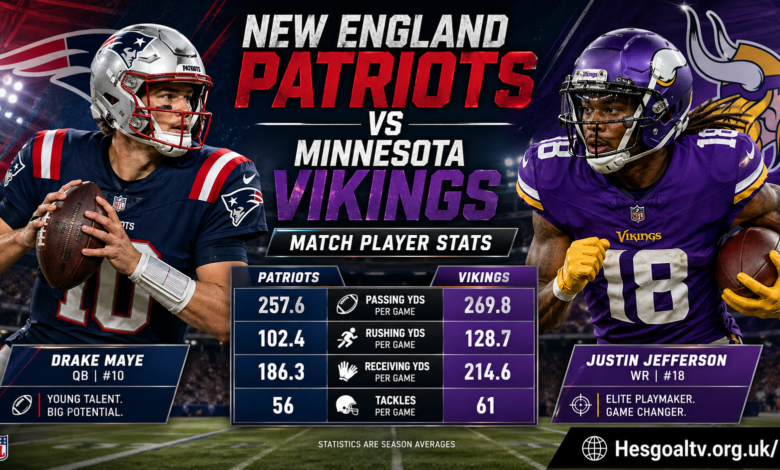
The New England Patriots vs Minnesota Vikings Match Player Stats from the 2025 preseason meeting tell the story of a disciplined New England performance, a developing Minnesota offense, and several young players fighting for stronger roles before the regular season. The Patriots defeated the Vikings 20-12 on August 16, 2025, at U.S. Bank Stadium, using early touchdowns, balanced offensive production, and timely defensive plays to control the game.
This matchup was not only about the final score. It was a useful preseason test for quarterbacks, rookies, backup skill players, offensive line rotations, defensive depth, and special teams execution. New England finished with 314 total net yards, while Minnesota produced 273, showing that the contest was competitive but still slightly tilted toward the Patriots in possession control, scoring efficiency, and overall balance.
New England Patriots vs Minnesota Vikings Match Player Stats Overview
The New England Patriots entered this preseason game looking for rhythm, depth, and sharper execution across their offensive units. Their 20-12 win over Minnesota came through a mix of early scoring, controlled passing, a steady ground game, and defensive pressure that disrupted the Vikings at important moments. New England scored seven points in each of the first two quarters and added two field goals in the fourth quarter to protect the lead.
Minnesota, on the other hand, stayed within reach for most of the contest but could not find the touchdown production needed to turn yardage into points. The Vikings scored through four Will Reichard field goals, which kept them alive but also highlighted their struggle to finish drives. In preseason football, that difference matters because coaches evaluate not only movement between the twenties but also execution in scoring range.
Complete Box Score Story
The Patriots built their advantage early when TreVeyon Henderson scored on an eight-yard run in the first quarter. That opening touchdown gave New England a 7-0 lead and allowed the team to play with confidence. In the second quarter, Joshua Dobbs connected with Efton Chism III for a 12-yard touchdown, extending the Patriots’ lead and giving the offense a strong first-half storyline.
Minnesota answered with a 34-yard field goal before halftime and added another long field goal in the third quarter, but the Vikings never found the end zone. The fourth quarter featured field goals from John Parker Romo and Andres Borregales for New England, while Reichard continued to supply all of Minnesota’s points. The final score reflected a game where New England made the bigger scoring plays and Minnesota settled too often.
Patriots Passing Performance
New England’s passing numbers were clean and efficient enough for a preseason win. Joshua Dobbs completed 11 of 16 passes for 106 yards, one touchdown, and no interceptions, giving the Patriots their most productive quarterback line of the game. His touchdown pass to Efton Chism III was one of the most important plays because it rewarded a long scoring drive and showed strong timing in the red zone.
Ben Wooldridge added 55 passing yards on 7 completions from 13 attempts, while Drake Maye completed 4 of 7 passes for 46 yards. As a team, New England finished 22 of 36 through the air for 207 yards, one touchdown, and no interceptions. That zero-interception line was important because it allowed the Patriots to control field position and avoid giving Minnesota easy scoring chances.
Vikings Passing Performance
Minnesota threw for more gross passing yards than New England, but the passing line was less efficient because of sacks, interceptions, and missed scoring chances. Max Brosmer completed 15 of 27 passes for 156 yards but threw one interception. Brett Rypien was more efficient with 7 completions on 11 attempts for 83 yards, while Sam Howell completed just 1 of 5 passes and also threw an interception.
The Vikings finished 23 of 43 passing for 219 net passing yards, but the offense suffered from two interceptions and four sacks. Those negative plays reduced the value of Minnesota’s passing yardage because they interrupted drives and gave New England’s defense control in key sequences. The numbers show that Minnesota could create some movement through the air, yet the team lacked the clean finishing touch needed to convert possession into touchdowns.
Patriots Rushing Attack
The Patriots’ running game was not explosive from start to finish, but it was useful and balanced. JaMycal Hasty led New England on the ground with 47 yards on 11 carries, giving the offense steady early-down production. TreVeyon Henderson carried only four times, but his 20 yards and first-quarter touchdown gave the Patriots a major scoring boost and showed why his preseason development was closely watched.
New England finished with 107 rushing yards on 34 attempts, which helped the team control time of possession and keep Minnesota’s defense working. Antonio Gibson added 17 yards on seven carries, while Shane Watts handled 10 carries for 15 yards. The average was modest, but the volume mattered because it helped New England protect its lead, manage the clock, and keep the offensive structure balanced.
Vikings Rushing Attack
Minnesota’s rushing attack had a harder time shaping the game. Zavier Scott led the Vikings with 28 yards on 10 carries, while Sam Howell added 14 yards on three attempts and Ty Chandler contributed 12 yards on three carries. The Vikings finished with only 54 rushing yards on 16 attempts, which made the offense more dependent on passing situations.
That limited rushing volume affected Minnesota’s overall rhythm. When a team cannot consistently run the ball in a preseason game, quarterbacks and receivers often face more obvious passing downs. That creates opportunities for sacks, pressure, and turnovers. Minnesota’s 3.4 yards per rush was not terrible, but the lack of rushing attempts and the absence of a rushing touchdown made the ground game less influential than New England’s.
Patriots Receiving Leaders
Efton Chism III was the clear receiving standout for New England. He caught six passes for 71 yards and one touchdown, leading the Patriots in receptions, receiving yards, and receiving scores. His 33-yard long reception also showed his ability to create impact beyond short gains. For a preseason player trying to earn more attention, that type of complete receiving line is highly valuable.
Mack Hollins added three catches for 38 yards, while John Jiles caught four passes for 24 yards. Kyle Williams also had three catches for 24 yards, giving New England multiple contributors in the passing game. The distribution was useful because it gave coaches a wider view of route running, timing, hands, yards after catch, and quarterback chemistry under live-game conditions.
Vikings Receiving Leaders
Minnesota’s receiving group had several productive individual moments despite the team’s lack of touchdowns. Tim Jones led the Vikings with five catches for 68 yards, providing the most consistent receiving output. Zavier Scott added three catches for 44 yards, showing value as a passing-game option out of the backfield. Jeshaun Jones also contributed four catches for 39 yards.
Tai Felton was efficient with two catches for 32 yards, while Nick Vannett added two receptions for 21 yards. The receiving totals show that Minnesota had enough passing production to move the ball, but not enough finishing power near scoring territory. When a team’s receiving leaders pile up catches without producing touchdowns, it often points to red-zone execution, drive timing, and situational play-calling issues.
Defensive Impact and Turnovers
The Patriots’ defensive performance was one of the biggest reasons they won. New England intercepted Minnesota twice, with Kyle Dugger and Alex Austin each recording an interception. Those turnovers were valuable because they prevented Minnesota from turning passing volume into stronger scoreboard pressure. A defense that creates takeaways in preseason gives coaches confidence in depth players, communication, and coverage discipline.
New England also recorded four sacks for 33 yards lost, while Minnesota did not sack Patriots quarterbacks. That difference shaped the passing comparison. Minnesota had more gross passing yards, but New England’s pressure reduced Minnesota’s net passing value and created difficult down-and-distance situations. Defensive pressure is especially important in preseason because it helps evaluate edge depth, linebacker timing, and secondary coverage under stress.
Team Stats Comparison
The team statistics explain why the Patriots controlled the game. New England had 314 total net yards compared with Minnesota’s 273, and the Patriots held the ball for 34:10 compared with the Vikings’ 25:50. That possession difference allowed New England to run more plays, manage the tempo, and keep Minnesota chasing the game for most of the afternoon.
New England also had 19 first downs compared with Minnesota’s 15. The Patriots converted 12 of 20 third downs, while the Vikings converted 5 of 15. That third-down gap was one of the clearest signs of difference between the teams. New England sustained drives more effectively, while Minnesota had too many possessions stall before reaching the end zone.
Special Teams and Field Position
Special teams played a major role in the final score because both teams relied on kicking during the second half. New England received field goals from John Parker Romo and Andres Borregales in the fourth quarter. Borregales also made extra points after the two Patriots touchdowns. Those kicks helped New England stretch the lead and made Minnesota’s comeback path more difficult.
Minnesota’s entire scoring output came from Will Reichard, who made field goals from 34, 54, 47, and 27 yards. His accuracy kept the Vikings competitive, but the pattern also revealed a problem: Minnesota reached scoring range without finishing drives. In a preseason evaluation, a reliable kicker is a positive, but a team still wants touchdowns when offensive possessions create opportunities.
Why the Patriots Won
The Patriots won because they made the most important plays in the most important moments. They scored the game’s only two touchdowns, protected the football, won the turnover battle, created sacks, and controlled possession. Even when their rushing average was not dominant, the Patriots kept their offense balanced enough to avoid predictable situations and maintain control. That combination is often enough to win preseason games.
The New England Patriots vs Minnesota Vikings Match Player Stats also show how New England separated itself through efficiency rather than pure explosiveness. The Patriots did not need huge passing totals or a 100-yard rusher because they avoided interceptions and turned key possessions into points. Minnesota had passing yardage and field goals, but New England had touchdowns, takeaways, and cleaner situational football.
What the Vikings Need to Improve
Minnesota’s biggest improvement area is finishing drives. The Vikings scored four field goals but no touchdowns, and that kept them behind even while they remained statistically competitive in passing yards. Preseason games are about evaluation, but red-zone and scoring-area execution remain important because they reveal timing, confidence, and communication across the offense. Minnesota moved the ball, but movement alone was not enough.
The Vikings also need to reduce negative plays. Four sacks and two interceptions damaged promising possessions and made the offense less efficient than the yardage totals suggest. Penalties were another issue, as Minnesota committed 10 penalties for 64 yards compared with New England’s 7 for 40. In close games, those hidden yards often become the difference between a touchdown drive and a field-goal attempt.
Player Stock Report
TreVeyon Henderson and Efton Chism III were two of the biggest stock-up names for New England. Henderson’s first-quarter touchdown gave the Patriots early control, while Chism’s six-catch, 71-yard, one-touchdown performance made him the most productive receiver in the game. Their production stood out because preseason football rewards players who make visible, repeatable plays in limited opportunities.
For Minnesota, Tim Jones and Will Reichard had positive individual takeaways. Jones led the receiving group with 68 yards, while Reichard provided all 12 points with four successful field goals. Still, the Vikings’ offensive stock as a unit was mixed because passing production did not lead to touchdowns. The defensive side also had moments, but the inability to create interceptions or sacks limited Minnesota’s impact.
Quarterback Evaluation
Joshua Dobbs gave New England the most effective quarterback performance of the game. His 106 passing yards, touchdown, and clean turnover line gave the Patriots the calm execution they needed. Drake Maye’s shorter appearance was also useful because he completed more than half of his attempts and avoided mistakes. Ben Wooldridge’s work added another evaluation layer for the coaching staff.
Minnesota’s quarterback evaluation was more complicated. Max Brosmer produced the most yardage but also threw an interception. Brett Rypien was efficient and avoided turnovers, while Sam Howell struggled in limited passing work and threw one interception. In preseason settings, coaches usually look beyond the box score, but the New England Patriots vs Minnesota Vikings Match Player Stats still provide a useful snapshot of decision-making and efficiency.
Rookie and Depth Player Importance
Preseason games are built for depth evaluation, and this contest offered plenty of material. New England received visible contributions from players trying to strengthen their roster cases, especially Henderson and Chism. A rookie running back scoring early and a young receiver leading the game in receiving production are exactly the types of performances that can influence coaching discussions after the final whistle.
Minnesota also had evaluation value despite the loss. Players such as Tim Jones, Zavier Scott, and Tai Felton gave the Vikings useful tape in the passing game. However, the team’s lack of touchdowns made it harder for offensive players to stand out in a complete way. In preseason football, a productive stat line becomes more powerful when it connects to scoring drives and winning situations.
Fantasy Football Takeaways
Fantasy football managers should treat this game carefully. Henderson’s touchdown and Chism’s receiving production were exciting, but preseason stats must always be balanced against snap counts, depth-chart roles, opponent rotations, and coaching plans. A strong August box score can introduce a player to fantasy watchlists, but it should not automatically guarantee regular-season volume or weekly fantasy value.
Still, the New England Patriots vs Minnesota Vikings Match Player Stats offer useful signals. Henderson showed touchdown ability and backfield burst, while Chism showed target command and receiving consistency. For deeper fantasy formats, those names may deserve monitoring. For Minnesota, Tim Jones and Zavier Scott had useful receiving lines, but the Vikings’ offensive touchdown drought makes their fantasy interpretation more cautious.
Historical Context of the Matchup
Patriots vs Vikings games always attract attention because both franchises have passionate fan bases and recognizable NFL histories. This meeting was only a preseason contest, so it should not be compared too strongly with regular-season or playoff games. However, preseason matchups can still shape fan conversation because they reveal roster depth, coaching priorities, and early player development.
The 2025 preseason result gave New England a confidence-building win and gave Minnesota a clear list of areas to review. For fans searching the matchup, the historical record may matter, but the most useful angle here is the immediate player performance. That is why the box score, scoring summary, and team statistics are more relevant than broad rivalry history for this specific article.
Main Lessons from the Game
The biggest lesson from this game is that efficiency beats empty yardage. Minnesota had enough passing production to stay competitive, but two interceptions, four sacks, and no touchdowns limited the value of those yards. New England, by contrast, produced fewer dramatic passing totals but scored two touchdowns, avoided turnovers, and controlled the ball longer. That difference shaped the final result.
Another lesson is that preseason wins are built through depth. Starters may not play full games, and coaches often test combinations, but every snap still matters for players trying to make a roster or earn a role. New England’s young contributors made their chances visible, while Minnesota’s individual positives were softened by team-level struggles in scoring situations.
Conclusion
The New England Patriots vs Minnesota Vikings Match Player Stats from the 2025 preseason game show a 20-12 Patriots win built on balanced offense, clean quarterback play, timely rushing, strong receiving from Efton Chism III, and defensive pressure that forced mistakes. New England did not dominate every category, but it won the categories that usually decide football games: touchdowns, turnovers, third downs, and possession control.
For Minnesota, the game offered useful individual performances but also exposed issues in finishing drives, protecting quarterbacks, and turning yardage into touchdowns. The Vikings stayed within range through reliable field-goal kicking, but the lack of offensive touchdowns prevented a comeback. Overall, the 2025 box score gives fans, writers, and analysts a clear picture of how New England controlled the game and why Minnesota fell short.
FAQs
What was the final score of the New England Patriots vs Minnesota Vikings 2025 game?
The New England Patriots defeated the Minnesota Vikings 20-12 in their 2025 preseason matchup on August 16, 2025. New England scored touchdowns in the first and second quarters, then added two fourth-quarter field goals. Minnesota scored all 12 of its points through field goals and did not record a touchdown in the game.
Who was the top passer for the Patriots?
Joshua Dobbs was the top passer for New England. He completed 11 of 16 passes for 106 yards, one touchdown, and no interceptions. His touchdown pass to Efton Chism III was one of the key offensive plays of the game and helped the Patriots build their early advantage.
Who led the Patriots in receiving yards?
Efton Chism III led the Patriots in receiving yards. He caught six passes for 71 yards and one touchdown, making him one of the standout players in the game. His performance was especially important because it combined volume, efficiency, and scoring impact in a preseason setting.
Which team had more total yards?
The Patriots had more total net yards than the Vikings. New England finished with 314 total net yards, while Minnesota finished with 273. The yardage difference was not enormous, but New England paired its yardage with better scoring efficiency, longer possession time, and stronger third-down performance.
Why did the Patriots win the game?
The Patriots won because they scored the only two touchdowns, protected the football, forced two interceptions, and controlled time of possession. Minnesota moved the ball at times, but the Vikings settled for field goals and lost momentum through sacks, turnovers, and penalties. Those details made the difference in a preseason game decided by eight points.
Was this a regular-season game?
No, this was a 2025 NFL preseason game. Preseason stats are useful for evaluating rookies, backups, roster battles, and team depth, but they should not be judged the same way as regular-season production. Coaches often rotate players and test schemes, which means context is important when reading the box score.
What does New England Patriots vs Minnesota Vikings Match Player Stats tell fans?
New England Patriots vs Minnesota Vikings Match Player Stats tells fans how each quarterback, running back, receiver, defender, and special teams unit performed. It also helps explain why New England won, why Minnesota struggled to finish drives, and which players improved their preseason outlook through visible production and situational execution.