
Colts vs Chargers Match Player Stats: Jonathan Taylor Powers Colts 38-24 Victory

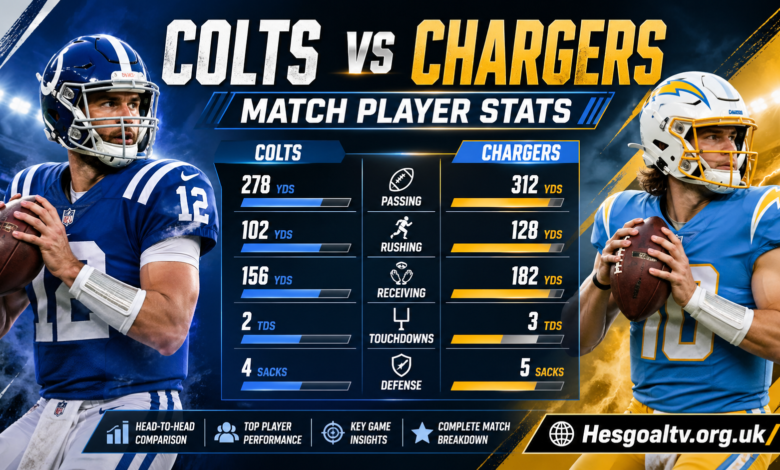
Colts vs Chargers Match Player Stats overview
Colts vs Chargers Match Player Stats became a highly searched topic because this Week 7 NFL meeting delivered a strong mix of rushing dominance, passing volume, red-zone execution, and defensive turning points. The Indianapolis Colts defeated the Los Angeles Chargers 38-24 on October 19, 2025, in a game where the final score showed how much early control and efficient scoring mattered. Indianapolis improved to 6-1, while Los Angeles fell to 4-3 after failing to turn yardage into enough points.
The story of the game was not only about total yards. The Chargers actually produced more total net yards, but the Colts were cleaner, sharper, and more dangerous in scoring situations. Jonathan Taylor gave Indianapolis the physical identity it needed, Daniel Jones managed the passing game with confidence, and the Colts defense created timely interceptions that damaged the Chargers’ comeback hopes.
Match summary and final score
The Colts won 38-24 by building a strong early advantage and refusing to let the Chargers’ passing attack fully change the direction of the game. Indianapolis started aggressively, scoring touchdowns on its first three drives and taking a 23-3 lead into halftime. That fast start forced Los Angeles to chase the scoreboard and made the Chargers more dependent on Justin Herbert’s arm.
Los Angeles did respond with explosive passing production, but the Chargers could not match the Colts’ balance. Indianapolis finished with 401 total net yards, while Los Angeles posted 445 total net yards. However, the difference came from rushing touchdowns, turnover timing, and red-zone control. The Chargers had possession for 34:27 compared with 25:33 for the Colts, but possession time did not decide the game.
Jonathan Taylor leads the Colts attack
Jonathan Taylor was the defining player of this matchup. He rushed 16 times for 94 yards, averaged 5.9 yards per carry, and scored three touchdowns. His performance gave Indianapolis control in the most important areas of the field, especially near the goal line. Whenever the Colts needed a reliable answer, Taylor provided power, patience, and finishing ability.
Taylor’s three touchdowns made the Chargers defense respect the run on almost every important down. That pressure opened space for play-action passing and helped Daniel Jones operate with rhythm. The biggest value of Taylor’s performance was not only his yardage total, but the way his physical running shaped the entire defensive reaction from Los Angeles.
Why Jonathan Taylor was the most valuable player
The best running back performances are not always about reaching 150 yards. In this game, Taylor’s value came from efficiency and scoring impact. He turned 16 carries into 94 yards and three touchdowns, which made nearly every Colts scoring drive feel controlled. His 23-yard long run also showed that he remained explosive beyond short-yardage situations.
Taylor forced the Chargers to defend horizontally and vertically. When a defense must prepare for inside runs, cutback lanes, screen threats, and play-action passes, it becomes harder to disguise coverage. That is why Taylor’s stat line was so important. He gave Indianapolis offensive balance, helped protect the lead, and made the Chargers defense uncomfortable throughout the game.
Daniel Jones passing performance
Daniel Jones played one of the most efficient roles in the Colts’ victory. He threw for 288 yards and two touchdowns, supporting the rushing attack without forcing unnecessary mistakes. His performance showed why balance matters in modern NFL offense. The Colts did not need Jones to throw 45 times because their run game and early scoring gave him a cleaner structure.
Jones’ passing performance also showed strong game management. He helped Indianapolis move the ball quickly in the first half, used his receivers well, and allowed the offense to stay unpredictable. His role was very different from Justin Herbert’s, who had to throw repeatedly from behind. Jones did not produce the larger passing total, but he produced the more winning-friendly performance.
Colts receiving stats and offensive balance
The Colts passing attack worked because several receivers contributed at useful moments. Alec Pierce, Tyler Warren, Michael Pittman Jr., Jonathan Taylor, and Ameer Abdullah all appeared in the receiving section of the box score, showing that Indianapolis did not rely on only one target. This distribution made the offense harder to defend and helped Daniel Jones avoid predictable reads.
Michael Pittman Jr. was especially important because of his touchdown contribution. Tyler Warren also delivered a scoring catch, giving the Colts another red-zone option. When an offense can score through both its running back and multiple receiving targets, the defense has fewer safe answers. That was one reason the Colts were able to turn strong drives into points.
Justin Herbert passing stats for the Chargers
Justin Herbert delivered a high-volume passing performance in defeat. He threw for 420 yards and three touchdowns, numbers that normally give a team a strong chance to win. However, he also threw two interceptions, and those turnovers became part of the reason the Chargers could not complete a comeback. Big passing yards helped Los Angeles stay alive, but mistakes reduced the value of that production.
Herbert’s game showed the difference between statistical volume and game control. He had to throw often because the Chargers trailed early, and that created opportunities for explosive plays. At the same time, it exposed Los Angeles to defensive pressure, tighter coverage, and riskier decisions. His final numbers were impressive, but the overall game script favored Indianapolis.
Chargers receiving leaders and breakout performance
The brightest Chargers offensive story was Oronde Gadsden II. He caught seven passes for 164 yards and scored his first career touchdown, producing a breakout performance in a difficult team loss. His ability to create chunk plays gave Los Angeles a needed spark and made him one of the standout individual performers in the matchup.
Gadsden’s performance mattered because the Chargers needed explosive receiving production to overcome their early deficit. Keenan Allen and other targets helped Herbert keep drives moving, but Gadsden gave the offense its most dangerous vertical and intermediate threat. Even though Los Angeles lost, his performance became one of the most important parts of the Chargers’ player stats.
Rushing comparison between Colts and Chargers
The rushing comparison clearly favored Indianapolis. The Colts produced 120 team rushing yards on 23 carries, averaging 5.2 yards per attempt, and all three of their rushing touchdowns came through Jonathan Taylor. The Chargers produced only 54 rushing yards on 16 carries, averaging 3.4 yards per attempt, with no rushing touchdowns.
This gap changed the entire game. Indianapolis could stay balanced, protect its lead, and make Los Angeles defend every part of the offense. The Chargers, meanwhile, became pass-heavy because their ground game did not provide enough support. When one team can run efficiently and the other must rely almost completely on passing, the balanced team usually controls the rhythm.
Passing comparison between both quarterbacks
The passing comparison is interesting because Herbert threw for far more yards, but Jones had the cleaner winning performance. Herbert’s 420 yards and three touchdowns showed elite arm talent and strong resilience, especially after the Chargers fell behind. Still, his two interceptions gave Indianapolis major defensive momentum and limited the effectiveness of his passing volume.
Jones threw for 288 yards and two touchdowns, which was exactly what Indianapolis needed. He did not have to chase the game or force deep throws into risky coverage. Instead, he used the run game, spread the ball, and helped Indianapolis maintain command. In the context of Colts vs Chargers Match Player Stats, Jones was the efficient winner while Herbert was the high-volume passer.
Team stats comparison
The team stats explain why the game was more complicated than the final score alone. Los Angeles had 445 total net yards, while Indianapolis had 401. The Chargers also had more time of possession, holding the ball for 34:27 compared with 25:33 for the Colts. But Indianapolis was far more effective at turning possessions into touchdowns.
First downs were also close, with the Football Database listing 24 for Indianapolis and 25 for the Chargers. That means Los Angeles moved the chains, but the Colts won the more valuable moments. Efficiency near the end zone, explosive rushing, and defensive takeaways mattered more than raw possession or total yardage numbers.
Defensive impact and turnovers
The Colts defense gave up passing yards, but it made the kind of plays that change games. Indianapolis intercepted Justin Herbert twice, including a notable interception by defensive tackle Grover Stewart highlighted by the Colts’ official game coverage. Those turnovers helped protect the Colts’ lead and prevented the Chargers from converting big yardage into a tighter score.
This defensive performance was not about completely shutting down Herbert. Instead, it was about winning selected moments. The Colts allowed yards, but they forced mistakes, tightened up when necessary, and gave their offense extra control. In NFL games, a defense can still be successful if it creates turnovers and prevents long drives from becoming touchdowns.
Key moments that changed the game
The first major turning point was the Colts’ fast start. Scoring touchdowns on their first three drives created pressure that changed the Chargers’ offensive plan. Instead of staying balanced, Los Angeles had to push the ball downfield and play from behind. That allowed Indianapolis to control the emotional direction of the game early.
Another key moment came through defensive disruption. Interceptions against Herbert slowed the Chargers’ comeback rhythm and gave Indianapolis more breathing room. Taylor’s touchdown runs were also major turning points because they punished the Chargers in the red zone. Every time Los Angeles looked ready to challenge, the Colts had a response through power running or timely defense.
Red-zone efficiency and scoring control
Red-zone efficiency was one of the biggest reasons Indianapolis won. The Colts did not simply collect yards; they finished drives. Jonathan Taylor’s three rushing touchdowns gave the offense a trusted red-zone formula, while receiving touchdowns from players such as Michael Pittman Jr. and Tyler Warren added variety. That variety made the Colts difficult to defend close to the goal line.
The Chargers had enough passing production to remain competitive, but their offensive rhythm was not as complete. They needed more help from the running game and fewer empty or damaged possessions. When a team throws for 420 yards but loses by 14 points, the issue is usually not movement. The issue is finishing, turnovers, and situational execution.
How the Colts controlled the first half
The Colts’ first-half performance created the foundation for the win. They built a 23-3 halftime lead behind 274 yards of offense and defensive takeaways, according to the Colts’ official recap. That kind of halftime margin allowed Indianapolis to play with confidence and forced the Chargers into a narrow comeback path.
A strong first half can make every later possession feel different. For the Colts, it meant they could continue using Taylor, manage the clock, and avoid panic. For the Chargers, it meant Herbert had to carry the offense through aggressive passing. The first half did not end the game, but it created the structure that Indianapolis used to win.
Why the Chargers could not complete the comeback
The Chargers could not complete the comeback because their offense became too dependent on one dimension. Herbert threw for 420 yards and three touchdowns, but the run game produced only 54 yards. Without a credible rushing threat, Indianapolis could focus more attention on passing situations and wait for mistakes.
The second reason was defensive failure against the Colts’ balanced attack. Los Angeles allowed touchdowns on Indianapolis’ first three drives and struggled to control Taylor in scoring areas. Even when the Chargers produced explosive plays, their defense could not consistently create stops early enough to shift momentum back in their favor.
Colts offensive line and run-blocking influence
Taylor’s numbers were also a reflection of strong blocking and offensive design. Running backs need timing, lane creation, and second-level movement to turn carries into efficient production. Indianapolis gave Taylor enough space to reach the line with patience and enough push to finish drives near the goal line. That made the run game reliable throughout the contest.
The offensive line also helped Daniel Jones. When the running game works, pass rushers cannot attack with full freedom, and linebackers become more vulnerable to hesitation. The Colts used that advantage well. Their blockers helped create an offensive rhythm that was physical, balanced, and difficult for the Chargers to solve before the score became too large.
Chargers defensive problems
The Chargers defense struggled because it could not remove Indianapolis’ first option. If Los Angeles had slowed Taylor early, the game might have moved into a more quarterback-heavy battle. Instead, the Colts established the run, scored early, and forced the Chargers defense to react rather than dictate. That made the matchup uncomfortable for Los Angeles.
Another issue was the failure to consistently defend scoring situations. Giving up 38 points at home shows problems beyond one or two plays. The Chargers had to handle Taylor’s power, Jones’ efficiency, and red-zone passing targets. They did not find a reliable answer quickly enough, and the scoreboard reflected that defensive instability.
Best Colts players in the game
Jonathan Taylor was clearly the top Colts player because his three touchdowns shaped the result. His 94 rushing yards gave Indianapolis a powerful base, and his scoring production turned drives into separation. He was not just a stat leader; he was the player who forced the Chargers defense to change its behavior throughout the game.
Daniel Jones also deserves major credit. His 288 passing yards and two touchdowns gave the Colts a complete offensive identity. Michael Pittman Jr. and Tyler Warren added touchdown value, while the defense produced important interceptions. Together, these performances made Indianapolis look balanced, disciplined, and dangerous on both sides of the ball.
Best Chargers players in the game
Justin Herbert was the most productive Chargers player by total yardage. His 420 passing yards and three touchdowns kept Los Angeles from being completely overwhelmed. Even though his two interceptions hurt, the Chargers remained competitive mainly because Herbert continued creating explosive passing chances after a difficult start.
Oronde Gadsden II was another major standout. His seven receptions for 164 yards and a touchdown gave the Chargers a breakout receiving performance. In a losing effort, those numbers were still meaningful. He created separation, produced chunk gains, and showed why he could become a larger part of the Chargers passing attack moving forward.
What the Colts did better than the Chargers
The Colts were better in the areas that decide NFL games most often. They ran the ball more effectively, finished drives with touchdowns, avoided falling into a one-dimensional offensive plan, and created timely turnovers. They did not need to dominate every statistical category because they dominated the most valuable situations.
Indianapolis also showed better game flow management. After building the early lead, the Colts did not abandon their identity. They continued trusting Taylor, gave Jones manageable passing situations, and let the defense attack Herbert when the Chargers became pass-heavy. That combination made the Colts look like the more complete team.
What the Chargers need to improve
The Chargers need more rushing consistency. A team with a quarterback like Herbert can produce explosive passing numbers, but long-term success still requires offensive balance. Against Indianapolis, Los Angeles had only 54 rushing yards and no rushing touchdowns. That limited their ability to control tempo and protect Herbert from high-pressure passing situations.
Defensively, the Chargers must improve early-game resistance and red-zone toughness. Allowing touchdowns on the Colts’ first three drives created a game script that favored Indianapolis. The defense needed quicker adjustments against Taylor and better execution against play-action concepts. Without those improvements, strong passing performances may continue to be wasted.
Player stats table for quick reference
Writers covering Colts vs Chargers Match Player Stats should include a clean player table near the top of the article. The most important entries are Jonathan Taylor with 16 carries, 94 rushing yards, and three touchdowns; Daniel Jones with 288 passing yards and two touchdowns; Justin Herbert with 420 passing yards, three touchdowns, and two interceptions; and Oronde Gadsden II with seven catches, 164 yards, and one touchdown.
A table improves user experience because searchers often want fast answers before reading full analysis. Use separate rows for passing, rushing, receiving, and turnovers. Add a short explanation under the table that reminds readers why the highest yardage total did not guarantee victory. This structure makes the article useful for both quick readers and detailed NFL fans.
Team stats table for quick reference
A strong team stats table should compare total yards, rushing yards, passing yards, first downs, penalties, and time of possession. The Chargers had 445 total net yards compared with 401 for the Colts, while Indianapolis had 120 rushing yards compared with 54 for Los Angeles. These numbers show the difference between total movement and complete offensive balance.
The table should also show that time of possession favored the Chargers, yet the result favored the Colts. This is a useful lesson for readers because football is not always decided by who holds the ball longer. The Colts scored more efficiently, created turnovers, and turned their rushing advantage into touchdowns.
Tactical analysis of the Colts offense
The Colts offense succeeded because it stayed balanced from the beginning. Taylor’s rushing threat pulled defenders toward the line, while Jones used passing opportunities to attack available space. This combination made Indianapolis difficult to predict. When a defense cannot clearly identify whether run or pass is coming, every snap becomes more stressful.
The Colts also used early success to control later decisions. Once they built the lead, they did not need to become reckless. Their offensive plan allowed them to continue attacking while reducing unnecessary risk. That is why the victory felt controlled despite the Chargers producing more total yardage. Indianapolis played with structure and purpose.
Tactical analysis of the Chargers offense
The Chargers offense showed explosive passing ability but lacked the balance needed to win comfortably. Herbert found receiving production, especially through Gadsden, and the offense moved the ball often enough to create statistical pressure. However, the absence of a consistent rushing attack made the offense easier to read in important moments.
When a team becomes predictable, even elite quarterback talent faces limits. Herbert could create yards, but the Colts defense could sit on passing situations, pressure throws, and hunt turnovers. The Chargers’ offense was dangerous, but it was not complete. That difference explains why impressive passing numbers did not turn into a comeback win.
Lessons from the Colts victory
The first lesson is that balance still matters in the NFL. Passing numbers attract attention, but rushing efficiency and red-zone power remain winning tools. The Colts used Taylor to make their offense more physical and more flexible. That gave them a stronger base than the Chargers had in this matchup.
The second lesson is that turnovers can outweigh yardage. Los Angeles moved the ball well, but Herbert’s two interceptions changed the value of those drives. Indianapolis did not need to stop everything. The Colts only needed to win enough high-leverage plays, and they did exactly that at the right moments.
Lessons from the Chargers defeat
The Chargers learned that explosive passing cannot cover every weakness. Herbert’s 420 passing yards and three touchdowns were strong, but the team still lost by 14 points. That type of result usually points to deeper issues in rushing support, defensive consistency, and situational football.
Los Angeles also learned the danger of slow starts. Falling behind 23-3 by halftime changed the entire game. The Chargers had enough talent to make plays, but the margin forced them into urgency. Against a balanced opponent like Indianapolis, early mistakes become extremely expensive.
Why this game matters for the Colts
This win mattered because it strengthened the Colts’ position as one of the NFL’s hottest teams at that point of the season. Indianapolis improved to 6-1 and earned an NFL-leading sixth victory, according to reports from the game. That record reflected not only talent, but also consistency and strong execution.
The win also showed that Indianapolis could defeat a talented AFC opponent with a complete formula. Taylor led the rushing attack, Jones made enough plays through the air, and the defense forced turnovers. That combination gave the Colts a blueprint that could remain effective against strong teams later in the season.
Why this game matters for the Chargers
For the Chargers, this game mattered because it exposed problems that raw passing numbers could not hide. Herbert’s production was impressive, but the team fell to 4-3 after struggling defensively and failing to establish enough rushing support. The loss showed that Los Angeles needed more balance to turn offensive talent into consistent wins.
The game also highlighted both concern and promise. The concern was defensive vulnerability, especially against the run and early scoring drives. The promise was Gadsden’s breakout performance and Herbert’s ability to keep attacking. If the Chargers could fix the structural issues, the offensive ceiling would remain high.
SEO writing angle for this topic
An article targeting Colts vs Chargers Match Player Stats should answer the searcher’s question quickly, then expand into deeper analysis. Many readers want the final score, top player stats, Jonathan Taylor’s touchdowns, Justin Herbert’s passing numbers, and team comparisons. Place those facts early so the article satisfies search intent immediately.
After the quick answers, the article should provide detailed sections on rushing, passing, receiving, defense, turnovers, and tactical lessons. This creates depth without keyword stuffing. The keyword should appear naturally in the title, introduction, one or two body sections, and conclusion. That is enough to support SEO while keeping the content readable.
Common mistakes to avoid in this article
Do not focus only on Herbert’s 420 passing yards. That number is important, but it does not explain why the Chargers lost. Writers should connect his yardage with the two interceptions, the weak rushing support, and the early deficit. Otherwise, the article will feel incomplete and misleading.
Do not ignore Taylor’s scoring impact. His 94 rushing yards may look modest compared with Herbert’s 420 passing yards, but his three touchdowns were more decisive. The best article should explain value, not just volume. That is the key to making player stats meaningful for readers.
Conclusion
Colts vs Chargers Match Player Stats tells the story of a game where balance defeated volume. The Colts won 38-24 because they ran the ball with authority, finished drives, protected their early lead, and forced key turnovers. Jonathan Taylor was the central figure with 94 rushing yards and three touchdowns, while Daniel Jones supported the attack with efficient passing.
The Chargers had impressive individual numbers from Justin Herbert and Oronde Gadsden II, but the team lacked the rushing support and defensive consistency needed to beat Indianapolis. Herbert’s 420 passing yards made the box score exciting, yet Taylor’s touchdowns made the result clear. In the end, Colts vs Chargers Match Player Stats proves that efficiency, balance, and situational execution matter more than yardage alone.
FAQs
Who won the Colts vs Chargers game?
The Indianapolis Colts won the game 38-24 against the Los Angeles Chargers on October 19, 2025. Indianapolis built a strong first-half lead and used Jonathan Taylor’s three rushing touchdowns to stay in control. The Chargers produced more total net yards, but the Colts were better in scoring situations and created key turnovers.
What were Jonathan Taylor’s stats against the Chargers?
Jonathan Taylor rushed 16 times for 94 yards and scored three touchdowns. He averaged 5.9 yards per carry and had a long run of 23 yards. His touchdown production made him the most important player in the game and gave the Colts a major red-zone advantage.
What were Justin Herbert’s stats against the Colts?
Justin Herbert threw for 420 yards, three touchdowns, and two interceptions. His passing numbers were excellent in terms of yardage and scoring, but the interceptions hurt the Chargers’ comeback chances. The game showed how difficult it is to win when a quarterback has to carry too much of the offense.
Who was the best player in Colts vs Chargers?
Jonathan Taylor was the best player because he scored three rushing touchdowns and gave the Colts control in the most important moments. Herbert and Gadsden had excellent numbers for the Chargers, but Taylor’s impact directly shaped the final score and helped Indianapolis finish drives with authority.
Why did the Chargers lose despite Herbert’s big passing numbers?
The Chargers lost because they lacked rushing balance, committed costly turnovers, and allowed the Colts to build a large early lead. Herbert’s 420 passing yards kept Los Angeles competitive, but the Chargers’ 54 rushing yards and defensive struggles made the comeback much harder.
What was the biggest difference between the Colts and Chargers?
The biggest difference was offensive balance. The Colts had 120 rushing yards and three rushing touchdowns, while the Chargers had only 54 rushing yards and no rushing touchdowns. Indianapolis could attack in multiple ways, while Los Angeles depended too heavily on passing.
What should be included in a Colts vs Chargers Match Player Stats article?
A complete article should include final score, top passing stats, rushing leaders, receiving leaders, defensive turnovers, team stats, red-zone performance, and key moments. It should also explain why Jonathan Taylor’s touchdowns mattered more than raw yardage and why Herbert’s passing total did not lead to a win.