
Introduction
The Utah Jazz and Los Angeles Lakers always bring a familiar Western Conference storyline: tradition, star power, rebuilding energy, and a fan base that watches every possession closely. This article focuses on Utah Jazz vs Lakers Match Player Stats, using the latest major meeting as the central reference point while explaining what the box score reveals about performance, momentum, and team direction.
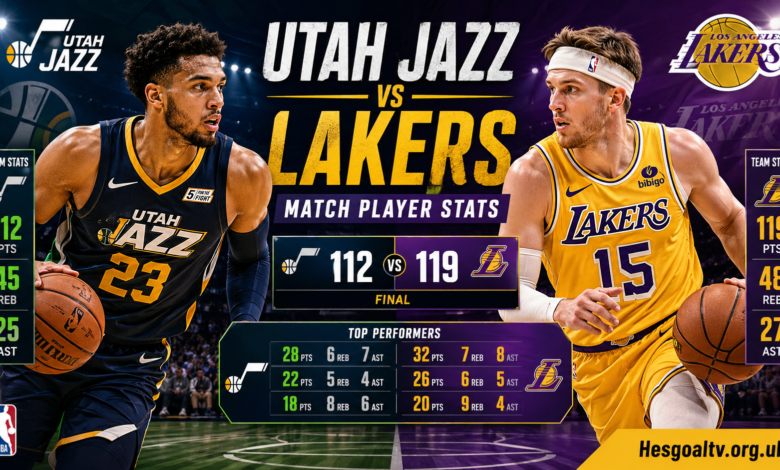
In the April 12, 2026 matchup, the Lakers defeated the Jazz 131-107 in Los Angeles. The scoreline showed a controlled Lakers performance, but the deeper numbers tell a richer story about shooting efficiency, rebounding pressure, bench production, defensive gaps, and individual leadership. The Lakers never allowed Utah to fully recover after a strong opening quarter.
Match Overview
The Lakers entered this game with playoff preparation in mind, while the Jazz used the night as another opportunity to evaluate young players, role pieces, and future rotation options. Los Angeles won every quarter, scoring 32, 30, 33, and 36 points across the four periods, which reflected balance rather than one short scoring burst.
Utah scored 22, 23, 29, and 33 points by quarter, improving offensively after halftime but never cutting the gap enough to create real late-game pressure. The Lakers’ 131-107 win was built on early control, better field-goal efficiency, strong frontcourt production, and a confident bench that kept the rhythm alive after key starters rested.
Full Box Score Story
The box score tells us that Los Angeles played with sharper offensive structure and better finishing around the rim. The Lakers shot efficiently, moved the ball well, and punished Utah whenever the Jazz defense lost shape. Their 131 points were not only the result of star talent but also the product of clean spacing, fast decisions, and repeated second-side attacks.
Utah’s 107 points were respectable, especially considering its stronger second-half scoring, but the Jazz could not match the Lakers’ pace or shot quality for long stretches. The Jazz allowed Los Angeles to score at least 30 points in every quarter, which made a comeback extremely difficult. In games like this, consistency matters more than one good scoring run.
Lakers Scoring Leaders
Rui Hachimura and Deandre Ayton were central figures in the Lakers’ scoring balance, with each player producing 22 points and 10 rebounds. Their matching double-doubles gave Los Angeles reliable frontcourt production and helped the team control the interior. When two starters finish with that level of scoring and rebounding, the opponent is forced to defend multiple threats at once.
LeBron James also made a strong first-half impact, scoring 18 points with six assists and four rebounds before being held out later as a precaution. His early command gave the Lakers rhythm, especially in transition and half-court organization. Even in limited minutes, his influence shaped the tone of the game and helped Los Angeles build control early.
Jazz Scoring Leaders
Oscar Tshiebwe delivered the standout performance for Utah, finishing with 29 points and 17 rebounds. His production gave the Jazz a major interior presence and showed his ability to battle physically against a strong Lakers frontcourt. For Utah, his effort was one of the clearest positives in a difficult road defeat.
The Jazz also received contributions from younger players and supporting pieces, but their offense lacked the same balance and efficiency as the Lakers. Utah needed more consistent shot-making from multiple positions to stay close. A strong individual scoring night can keep a team competitive, but against a deep opponent, one major performance is rarely enough.
Rebounding Battle
Rebounding was one of the most important parts of this game because both teams had physical frontcourt players capable of controlling possessions. Ayton and Hachimura each grabbed 10 rebounds for the Lakers, while Tshiebwe’s 17 rebounds gave Utah a major individual advantage in that category. The matchup showed how interior effort can shape momentum even when the final score is lopsided.
However, rebounding is not only about totals. It is also about timing, positioning, and whether boards lead to useful possessions. The Lakers converted their rebounding into rhythm, transition chances, and second-unit confidence. Utah had strong individual rebounding from Tshiebwe, but the team could not turn that advantage into enough defensive stops or sustained scoring pressure.
Assist and Playmaking Analysis
LeBron James gave the Lakers early passing control with six first-half assists, while Marcus Smart also played a key organizing role. Reports from the game highlighted Smart’s double-digit assist contribution, which helped Los Angeles maintain flow even when starters were managed carefully. Good assist numbers often show that a team is creating quality shots rather than relying on isolation.
For the Jazz, playmaking was more uneven. Utah had moments of ball movement, especially when younger players attacked quickly, but the Lakers’ defensive structure forced difficult possessions. When a team trails early, playmakers often feel pressure to create faster shots. That can lead to rushed decisions, lower efficiency, and fewer clean passing sequences.
Shooting Efficiency
Shooting efficiency separated the two teams more clearly than the final score alone. The Lakers’ offense created cleaner looks, especially through paint touches, transition spacing, and open perimeter chances. When Los Angeles got downhill, Utah’s defense had to collapse, which opened passing lanes for shooters and cutters.
The Jazz struggled to match that shot quality for most of the night. Utah had individual success inside, especially through Tshiebwe, but its overall offense needed more reliable perimeter support. In modern NBA games, strong interior scoring must be paired with efficient three-point shooting and low turnovers. Without that balance, even a good scoring quarter can disappear quickly.
Three Point Impact
The Lakers’ bench shooting was a major part of the game’s rhythm. Dalton Knecht scored 17 points off the bench and made five three-pointers, while Bronny James added 11 points and hit three shots from deep. Those contributions kept Los Angeles comfortable after the starters had already created the foundation.
For Utah, defending the three-point line became harder because the Lakers were also strong inside. When a team has to protect the paint and chase shooters, defensive rotations become longer and more demanding. That is where the Jazz lost ground. The Lakers stretched the floor, forced closeouts, and made Utah react instead of dictate.
Defensive Performance
The Lakers’ defense did not completely shut down Utah, but it controlled the game’s shape. Los Angeles built a lead, forced Utah to play from behind, and used its size to make finishing more difficult. Ayton’s interior presence, along with active wing defense, helped the Lakers reduce easy scoring chances during key stretches.
Utah’s defense had a more difficult night because the Lakers attacked from several areas. The Jazz had to deal with LeBron’s playmaking, Ayton’s inside scoring, Hachimura’s mid-range and cutting impact, and bench shooting. When too many players become threats, defensive communication must be nearly perfect. Utah did not reach that level often enough.
Bench Performance
The Lakers’ bench was one of the most important stories of the night. Los Angeles received scoring from every available player, and the second unit did more than protect the lead. It extended the advantage, played with confidence, and gave the coaching staff more evidence that the roster had useful postseason depth.
Dalton Knecht, Bronny James, Nick Smith Jr., Jarred Vanderbilt, and other bench pieces all contributed in different ways. This mattered because the Lakers were managing key players and still needed energy. A productive bench can turn a comfortable win into a statement win, especially when young players perform well in meaningful minutes.
Key Moments
The first quarter was a key moment because Los Angeles immediately created separation. A 32-22 opening period gave the Lakers a 10-point lead and forced Utah into chase mode. From there, every Jazz mistake became more costly. The Lakers did not need a dramatic comeback or late heroics because they controlled the game early.
The third quarter also mattered because the Lakers pushed the lead further instead of allowing Utah back into the contest. Los Angeles won that period 33-29, keeping its offensive pace steady. By the time the fourth quarter arrived, the Jazz needed a major run, but the Lakers’ bench continued scoring and protected the advantage.
Player Matchups
The frontcourt matchup was one of the most interesting parts of the game. Ayton and Hachimura both produced double-doubles, while Tshiebwe answered with a powerful 29-point, 17-rebound performance. That made the paint battle competitive individually, even though the Lakers were better as a complete unit.
The perimeter matchup favored Los Angeles because the Lakers received more efficient creation and better shooting support. LeBron’s early playmaking, Smart’s passing, Knecht’s outside shooting, and Bronny’s bench scoring gave the Lakers more variety. Utah had effort and individual flashes, but Los Angeles had the more complete guard-wing combination.
Lakers Team Strengths
The Lakers’ biggest strength in this matchup was balance. They did not depend on one scorer to carry the night. Hachimura, Ayton, LeBron, Knecht, Smart, and other contributors all shaped the game in different ways. That variety made the offense harder to predict and helped Los Angeles avoid long scoring droughts.
Another strength was game management. The Lakers built a lead early, protected it through the middle quarters, and gave key players rest without losing command. For a team preparing for the playoffs, that is an ideal regular-season finish. It shows confidence, depth, and the ability to win without overusing veterans.
Jazz Team Strengths
Utah’s clearest strength was effort from players still trying to prove long-term value. Tshiebwe’s performance was a strong example of physical commitment, rebounding hunger, and scoring confidence. Even in defeat, those numbers matter because rebuilding teams need to identify which players can handle real NBA minutes.
The Jazz also showed second-half persistence. They scored 29 in the third quarter and 33 in the fourth, which suggests they did not stop competing after falling behind. That response is important for a young group. Losing by a wide margin is disappointing, but continuing to attack can still reveal useful player development signs.
Jazz Weaknesses
Utah’s main weakness was defensive consistency. Giving up 30 or more points in every quarter makes winning nearly impossible, especially on the road against a playoff-level opponent. The Jazz did not contain the Lakers’ early rhythm, and once Los Angeles became comfortable, the game moved at the Lakers’ preferred pace.
Another weakness was limited scoring balance. Tshiebwe produced at a high level, but Utah needed more efficient support across the roster. Against a team like the Lakers, one strong individual performance must be supported by perimeter shooting, secondary creation, and defensive stops. Utah had moments, but not enough complete stretches.
What the Stats Reveal
Utah Jazz vs Lakers Match Player Stats reveal that Los Angeles won because of balance, efficiency, depth, and early control. The Lakers had strong frontcourt production, useful bench shooting, and enough playmaking to keep the offense organized. Their scoring pattern across all four quarters showed consistency rather than randomness.
The stats also reveal that Utah had individual positives but team-level problems. Tshiebwe’s numbers were impressive, yet the Jazz could not defend well enough to stay close. This is the difference between a productive individual night and a winning team performance. The Lakers turned multiple contributions into a complete result.
Season Context
This game closed the Lakers’ regular season with a 53-29 record and helped secure their position as the fourth seed in the Western Conference playoff picture. That context made the win more meaningful because Los Angeles used the night to sharpen rhythm, rest key players, and build confidence before the postseason.
For Utah, the loss was part of a difficult season that ended with a 22-60 record. However, the Jazz still had developmental value to evaluate. A rebuilding team often looks beyond the final score to study effort, growth, decision-making, and which players might become part of the next competitive roster.
Previous Matchup Context
The Jazz and Lakers had already produced dramatic games earlier in the season. In December 2025, Los Angeles beat Utah 143-135 behind a huge Luka Doncic triple-double, with Doncic scoring 45 points while adding 14 assists and 11 rebounds. That game showed the offensive ceiling of this matchup when both teams trade baskets.
Compared with that high-scoring December meeting, the April 2026 game was more controlled by the Lakers. The score was still high, but the feeling was different. Instead of a tight offensive duel, Los Angeles built a lead and maintained authority. That contrast helps readers understand why every Lakers-Jazz box score needs context.
Why This Match Matters
This game matters because it showed the Lakers entering the postseason with confidence, health management, and roster-wide contribution. A final regular-season game can sometimes feel routine, but this one gave Los Angeles a clean performance. The starters set the tone, and the bench turned the night into a comfortable win.
It also matters for Utah because the Jazz needed to measure young talent against a stronger opponent. Even in defeat, games against playoff teams can expose useful truths. They show who can rebound through contact, who can defend under pressure, who can create shots, and who still needs more development.
Fan Takeaways
For Lakers fans, the biggest takeaway is that the team looked deep, organized, and ready for higher-pressure basketball. Hachimura and Ayton gave strong frontcourt production, LeBron controlled the early tempo, and the bench brought shooting and energy. That is exactly the type of formula fans want to see before the playoffs.
For Jazz fans, the takeaway is more developmental. Tshiebwe’s performance was a bright sign, and the team continued to compete offensively after halftime. The final score was not close, but rebuilding seasons are often about identifying future pieces. Utah still needs defensive growth, but individual progress can become the foundation for future improvement.
SEO Summary of the Game
Utah Jazz vs Lakers Match Player Stats show a clear Lakers advantage in team balance, shooting rhythm, and bench scoring. The final score, 131-107, reflects how Los Angeles controlled the night from the first quarter onward. The Lakers created separation early, maintained pressure, and received production from both starters and reserves.
For writers covering this topic, the best angle is not only the final score. The stronger article angle is the full story behind the numbers: Ayton and Hachimura’s double-doubles, LeBron’s early impact, Tshiebwe’s standout effort, Lakers bench scoring, Utah’s defensive struggles, and the playoff context surrounding the Lakers’ final regular-season win.
Conclusion
Utah Jazz vs Lakers Match Player Stats tell the story of a complete Lakers win and a Jazz team still searching for consistency. Los Angeles won 131-107 by combining efficient scoring, strong rebounding, smart playmaking, and deep bench production. The Lakers controlled the game from the opening quarter and never allowed Utah to build serious pressure.
The Jazz still found positives through Oscar Tshiebwe’s excellent scoring and rebounding performance, along with late-game offensive effort. However, the Lakers had too many weapons and too much structure. For fans, analysts, and writers, this matchup offers a useful example of how box score details explain not only who won, but why the game developed the way it did.
FAQs
What was the final score of the Utah Jazz vs Lakers game?
The Lakers defeated the Utah Jazz 131-107 on April 12, 2026. Los Angeles won every quarter and controlled the game from the beginning. The Lakers scored at least 30 points in each period, which made it very difficult for Utah to build a realistic comeback.
Who were the top Lakers players in the match?
Rui Hachimura and Deandre Ayton were two of the leading Lakers players, with each recording 22 points and 10 rebounds. LeBron James also made a strong first-half impact with 18 points, six assists, and four rebounds before resting later in the game.
Who was the best Utah Jazz player against the Lakers?
Oscar Tshiebwe was the standout player for the Jazz. He finished with 29 points and 17 rebounds, giving Utah strong interior production. His performance was one of the biggest positives for the Jazz despite the team’s 131-107 loss.
What do Utah Jazz vs Lakers Match Player Stats show about the game?
Utah Jazz vs Lakers Match Player Stats show that the Lakers won through balance, efficient scoring, frontcourt strength, and bench production. Utah had individual bright spots, especially from Tshiebwe, but the Jazz could not defend consistently enough to stay close.
Why did the Lakers beat the Jazz?
The Lakers beat the Jazz because they started strongly, scored efficiently, controlled the pace, and received production from multiple players. Their bench also played well, helping protect and extend the lead after key starters rested in the second half.
Did the Lakers bench play well?
Yes, the Lakers bench played very well. Dalton Knecht, Bronny James, Nick Smith Jr., and other reserves contributed important minutes. The bench scoring helped Los Angeles maintain control and showed the team’s depth before the playoffs.
What was the biggest weakness for the Jazz?
The biggest weakness for the Jazz was defensive consistency. Utah allowed 30 or more points in every quarter, which created too much pressure on its offense. Even with strong individual scoring from Tshiebwe, the Jazz could not slow the Lakers enough.
Why are match player stats important in NBA analysis?
Match player stats are important because they explain the story behind the final score. Points, rebounds, assists, shooting percentages, steals, blocks, and bench scoring help fans understand which players shaped the game and which team had the stronger overall performance.