
Introduction
The 2026 meeting between the San Antonio Spurs and the Los Angeles Lakers gave basketball fans a box score filled with star power, speed, size, and sharp execution. The game ended with San Antonio defeating Los Angeles 136–108 at crypto.com Arena, after a dominant offensive display that started in the first quarter and never truly slowed down.
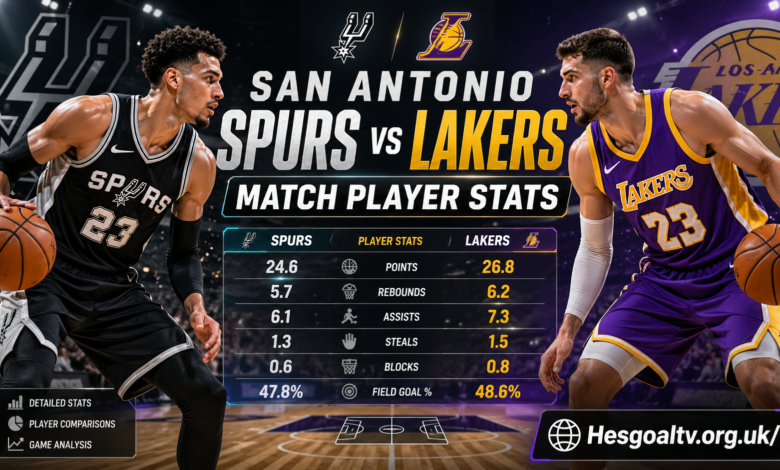
For readers searching for San Antonio Spurs vs Lakers Match Player Stats, this article breaks down the complete performance story behind the final score. It covers team numbers, player impact, shooting efficiency, rebounds, assists, turnovers, bench scoring, and the key reasons why the Spurs controlled the game from opening tip to final buzzer.
Match Overview
The Spurs entered the night as a confident Western Conference contender and played like a team with rhythm, spacing, and purpose. They scored 47 points in the first quarter, followed by 37 in the second, building an 84–55 halftime lead that turned the game into a showcase of San Antonio’s offensive balance and Los Angeles’ defensive problems.
The Lakers, playing at home, could not match the Spurs’ pace or interior pressure. Los Angeles scored 30 points in the first quarter, but the defensive gap widened quickly. By the time the third quarter ended, San Antonio had already reached 115 points, giving the visitors complete control before the final period.
Complete Box Score Story
The full box score tells a clear story of efficiency and control. San Antonio shot 52-of-92 from the field for 57 percent, while the Lakers made 41-of-85 shots for 48 percent. The Spurs also won the rebounding battle 45–34 and recorded 34 assists compared with 23 for Los Angeles.
Even though the Lakers shot slightly better from three-point range at 44 percent compared with San Antonio’s 39 percent, the Spurs dominated the higher-value areas of the game. They scored 72 points in the paint, produced 25 fast-break points, forced 18 Lakers turnovers, and built a largest lead of 41 points.
San Antonio Spurs Player Performance
Victor Wembanyama was the central figure in the Spurs’ victory. He scored 40 points in only 26 minutes, shooting 13-of-20 from the field, 4-of-6 from three, and 10-of-12 at the free-throw line. He also added 12 rebounds, 2 assists, 2 steals, and 1 block, giving San Antonio a complete two-way performance.
The rest of the Spurs’ rotation supported him with efficient, connected basketball. De’Aaron Fox added 8 points and 6 assists in limited minutes, Devin Vassell scored 9 points on 4-of-5 shooting, and Stephon Castle contributed 7 assists. The Spurs did not need one player to carry every possession because their ball movement created quality chances throughout the night.
Los Angeles Lakers Player Performance
The Lakers had several players reach double figures, but their production did not match San Antonio’s explosive scoring. Luke Kennard led the Lakers starters with 14 points and 5 assists, while Jaxson Hayes added 13 points on highly efficient 6-of-7 shooting. Jake LaRavia also scored 10 points, but the Lakers struggled to create enough defensive resistance.
From the bench, Drew Timme scored 14 points, Bronny James added 12 points and 6 assists, and Dalton Knecht scored 9 points. Those numbers gave Los Angeles some offensive variety, yet the bench production came after the Spurs had already created a large gap. The Lakers needed stops, not only scoring, and that was where the game slipped away.
Victor Wembanyama’s Dominant Impact
Wembanyama’s performance was the headline because it changed the shape of the game early. His scoring touch, length, and shooting confidence forced the Lakers into difficult defensive choices. When they gave him space, he punished them from outside. When they played closer, he attacked inside or drew fouls.
His 40-point performance was not empty scoring. It came with strong efficiency, rebounding control, and defensive presence. The most impressive part was how quickly he did the damage. Producing 40 points in 26 minutes showed how little time San Antonio needed from him to decide the game.
Spurs Offensive Efficiency
San Antonio’s offense looked smooth because it combined transition speed with half-court patience. The Spurs finished with 34 assists, which showed how often they turned good shots into better shots. The ball did not stay in one player’s hands too long, and the Lakers struggled to rotate quickly enough.
The Spurs also scored 72 points in the paint, a massive number that exposed Los Angeles’ lack of interior control. This was not only about dunks or layups. It reflected driving lanes, smart cuts, offensive positioning, and the pressure created by Wembanyama’s gravity near the rim.
Lakers Offensive Response
Los Angeles did not have a terrible shooting night by percentage, which makes the result more interesting. The Lakers shot 48 percent from the field and 44 percent from three, numbers that are usually competitive. Their problem was volume, turnovers, rebounding, and the inability to stop San Antonio’s repeated scoring runs.
The Lakers produced 108 points, but much of their offense felt reactive. They were often trying to answer a Spurs run rather than establishing their own rhythm. When a team falls behind by nearly 30 at halftime, even solid shooting numbers can become secondary to defensive breakdowns and lost possessions.
Rebounding Battle
San Antonio controlled the glass with 45 total rebounds, including 36 defensive rebounds and 9 offensive rebounds. Los Angeles finished with 34 rebounds, including only 5 offensive boards. That difference helped the Spurs protect possessions and limited the Lakers’ chances to build second-chance momentum.
Wembanyama’s 12 rebounds were especially important because they allowed San Antonio to finish defensive stops cleanly. The Lakers had players who contributed on the boards, but they did not have enough collective rebounding pressure to slow down San Antonio’s possession advantage.
Assists and Ball Movement
The assist difference was one of the strongest indicators of team rhythm. San Antonio finished with 34 assists, while Los Angeles had 23. That gap showed how well the Spurs shared the ball and how often their offense created open looks through passing rather than isolation.
Stephon Castle’s 7 assists and De’Aaron Fox’s 6 assists gave San Antonio strong guard play, while Jordan McLaughlin added another 6 assists from the bench. For the Lakers, Luke Kennard and Bronny James each had notable playmaking stretches, but Los Angeles did not generate the same consistent passing flow.
Defensive Pressure and Turnovers
San Antonio forced 18 Lakers turnovers and recorded 14 steals, while the Lakers had only 7 steals. This defensive activity gave the Spurs more transition chances and kept Los Angeles from finding a steady offensive rhythm. Turnovers became especially damaging because San Antonio converted mistakes into fast points.
The Spurs also committed only 13 turnovers, which meant their own offense remained clean enough to keep pressure on the Lakers. In a game with a fast pace and many possessions, protecting the ball while forcing mistakes became one of the clearest reasons for San Antonio’s comfortable win.
Shooting Breakdown
The Spurs’ 57 percent field-goal shooting was the most important shooting number of the night. It reflected quality shot selection, paint dominance, and strong finishing. Their 13 made threes also kept the Lakers from packing the paint too heavily, creating a balanced attack across all scoring levels.
Los Angeles did shoot 11-of-25 from three, a strong 44 percent mark. However, the Lakers attempted fewer threes and could not match San Antonio’s interior scoring. The Spurs’ ability to win inside while still shooting efficiently from deep made their offense difficult to defend.
Points in the Paint
The paint battle was one of the biggest differences in the San Antonio Spurs vs Lakers Match Player Stats breakdown. San Antonio scored 72 points in the paint compared with 50 for Los Angeles, and that 22-point gap gave the Spurs a strong foundation even before three-point shooting and free throws were considered.
Those paint points came from different sources. Wembanyama scored through size and touch, guards created downhill pressure, and cutters found space behind the defense. The Lakers allowed too many direct paths to the rim, and once San Antonio established confidence inside, the game opened up everywhere else.
Fast-Break Advantage
San Antonio also controlled the open floor, scoring 25 fast-break points compared with 15 for the Lakers. This mattered because transition baskets are often momentum plays. They are quick, efficient, and emotionally damaging for the defense, especially when they follow turnovers or missed shots.
The Spurs’ pace made the Lakers uncomfortable. Los Angeles could not always organize its half-court defense before San Antonio attacked. That early pressure created layups, rhythm threes, and defensive confusion, helping the Spurs build their huge first-half lead.
Bench Performance Analysis
San Antonio’s bench added balance and kept the game from turning into a one-man performance. Harrison Barnes scored 11 points, Keldon Johnson added 16, and Jordan McLaughlin contributed 15 points with 6 assists. Those bench numbers gave the Spurs reliable production even when starters rested.
The Lakers bench also had useful scoring, especially from Drew Timme, Bronny James, and Dalton Knecht. Still, the bench entered a difficult game environment because San Antonio’s lead was already large. Los Angeles needed bench players to change the game defensively, but the Spurs continued to score efficiently.
Quarter-by-Quarter Analysis
The first quarter decided the tone. San Antonio scored 47 points in the opening period, creating immediate pressure on the Lakers. Los Angeles scored 30, which is not a poor offensive quarter, but giving up 47 at home created a mountain that became difficult to climb.
The second quarter widened the gap even more, with the Spurs winning it 37–25. By halftime, San Antonio led 84–55. The third quarter added another 31 Spurs points, and although the Lakers won the fourth quarter 27–21, the game had already been effectively decided before then.
Key Moments That Changed the Game
The first major turning point was San Antonio’s explosive start. A team that scores 47 points in the first quarter forces the opponent to abandon patience early. The Lakers were pushed into catch-up mode almost immediately, and that changed their shot selection and defensive energy.
Another key moment was Wembanyama’s first-half scoring burst. His ability to score from multiple areas gave San Antonio control of the matchup. When a player of his size and skill gets hot early, the defense must adjust, and those adjustments often open chances for everyone else.
Spurs Season Series Context
This game also mattered because it completed a strong season series for San Antonio. ESPN’s matchup summary shows that the Spurs won the season series 3–1 against the Lakers, making this result more than a single impressive night. It showed repeated success across multiple meetings.
For the Lakers, losing the season series highlighted matchup concerns. San Antonio’s length, guard speed, and interior scoring gave Los Angeles repeated problems. In any future meeting, the Lakers would need a more disciplined defensive plan and stronger rebounding execution.
Lakers Weaknesses Exposed
The Lakers’ biggest weakness in this game was defensive containment. They allowed 136 points, 57 percent shooting, and 72 points in the paint. Those numbers point to problems at the point of attack, in rotation timing, and in protecting the rim against San Antonio’s size and movement.
Turnovers were another issue. The Lakers committed 18 turnovers, which fed San Antonio’s transition attack. Against a team with fast guards and an elite finishing threat like Wembanyama, live-ball turnovers are especially dangerous because they often lead to easy baskets before the defense is set.
Spurs Strengths Confirmed
For San Antonio, the game confirmed several strengths. The Spurs had elite interior scoring, strong passing, active defense, and enough bench depth to keep the scoreboard moving. Their ability to generate 34 assists showed that the system was working beyond individual talent.
The team also showed maturity by building a lead and maintaining control. Blowout wins sometimes become loose, but San Antonio kept its structure for most of the night. That discipline is important for a young, ambitious team trying to prove it can compete at a high level.
Best Player of the Match
The best player of the match was clearly Victor Wembanyama. His 40 points, 12 rebounds, efficient shooting, and defensive activity made him the defining figure in the game. He did not only lead the box score; he shaped the entire tactical identity of the contest.
In any San Antonio Spurs vs Lakers Match Player Stats review, Wembanyama’s line stands out because of both production and timing. He delivered early, forced defensive changes, and helped the Spurs create a lead that Los Angeles never seriously threatened.
Most Important Team Stat
The most important team stat was points in the paint. San Antonio’s 72 paint points gave the Spurs a reliable scoring base that did not depend only on jump shooting. When a team dominates inside at that level, it usually controls tempo, fouls, rebounds, and defensive spacing.
The assist total was nearly as important. San Antonio’s 34 assists showed that the Spurs were not simply relying on difficult individual shots. They were creating clean looks through movement, spacing, and quick decisions, which made the offense sustainable throughout the game.
What the Result Means for San Antonio
For the Spurs, this win was a statement of growth and authority. Beating the Lakers in Los Angeles by 28 points showed that San Antonio could impose its identity against a major Western Conference opponent. It also strengthened the idea that Wembanyama was becoming a true franchise-changing force.
The box score reflected a team with balance, not only a superstar with a great night. San Antonio had scoring from starters and bench players, strong defensive pressure, and excellent passing. Those are signs of a team that can win in different ways.
What the Result Means for Los Angeles
For the Lakers, the result raised questions about defensive depth, rotation balance, and interior resistance. Scoring 108 points is not a disaster, but allowing 136 at home is a serious concern. The Lakers needed more physicality, better transition defense, and stronger communication.
The game also showed that efficient shooting alone is not enough. Los Angeles shot well from three, but the Spurs won too many other categories. Rebounds, turnovers, assists, paint scoring, and fast-break production all leaned heavily toward San Antonio.
Head-to-Head Rivalry Angle
The Lakers and Spurs have a long history of meaningful Western Conference matchups. Their rivalry has included superstar eras, playoff battles, and championship-level basketball. Even when the teams are built differently, their meetings attract attention because both franchises carry strong historical weight.
This 2026 matchup added a modern layer to that rivalry. The Lakers represented established spotlight and star tradition, while the Spurs brought a new era led by Wembanyama. That contrast made the game more than a regular-season box score.
Why Fans Search This Matchup
Fans search for San Antonio Spurs vs Lakers Match Player Stats because the matchup combines big-market attention, historic rivalry value, and elite individual talent. Lakers games naturally draw national interest, while the Spurs have become must-watch because of Wembanyama’s unique skill set.
Searchers usually want more than the final score. They want to know who scored, who rebounded, who assisted, which team shot better, and why the game changed. A complete box score article answers all of those questions in one place.
Complete Game Takeaway
The complete takeaway is simple: San Antonio controlled the game through efficiency, size, ball movement, and defensive pressure. The Spurs did not win because of one lucky shooting stretch. They won because they dominated the highest-impact areas of the box score.
Los Angeles had respectable offensive moments, but the Lakers never found the defensive control needed to make the game competitive. Once San Antonio built its first-half lead, the Lakers spent the rest of the night trying to manage the damage rather than truly changing the result.
Conclusion
The San Antonio Spurs vs Lakers Match Player Stats analysis shows a complete Spurs performance built around Victor Wembanyama’s 40-point night, strong team passing, paint dominance, and defensive activity. San Antonio won 136–108, controlled the quarters early, and finished with clear advantages in rebounds, assists, steals, fast-break points, and points in the paint.
For the Lakers, the game was a reminder that shooting percentages do not tell the entire story. Los Angeles made shots, but San Antonio controlled possessions, spacing, tempo, and physical areas. The final box score was not just a win for the Spurs; it was a statement about their growing identity in the 2026 NBA season.
FAQs
What was the final score of the San Antonio Spurs vs Lakers game?
The San Antonio Spurs defeated the Los Angeles Lakers 136–108 on February 10, 2026. San Antonio started fast with 47 points in the first quarter and built an 84–55 halftime lead that shaped the rest of the game.
The Lakers scored 108 points and had some efficient shooting stretches, but they could not slow down the Spurs’ offense. San Antonio’s early scoring burst, paint dominance, and ball movement made the final margin comfortable.
Who was the top scorer in the game?
Victor Wembanyama was the top scorer with 40 points for the San Antonio Spurs. He shot 13-of-20 from the field, 4-of-6 from three-point range, and 10-of-12 from the free-throw line, making his scoring performance highly efficient.
His impact went beyond scoring because he also collected 12 rebounds and contributed defensively. His performance was the main reason the Spurs controlled the game so early and kept the Lakers under pressure.
Who had the most rebounds in the Spurs vs Lakers game?
Victor Wembanyama had the most rebounds in the game with 12. His defensive rebounding helped San Antonio finish possessions and prevent the Lakers from building second-chance scoring momentum.
San Antonio also won the overall rebounding battle 45–34. That team advantage allowed the Spurs to control possession flow and support their fast, efficient offensive rhythm.
Which team had better shooting stats?
San Antonio had the better overall shooting performance, making 52 of 92 field goals for 57 percent. The Lakers shot 41-of-85 from the field for 48 percent, which was solid but not enough to match San Antonio’s offensive explosion.
Los Angeles did shoot better from three-point range, hitting 44 percent compared with San Antonio’s 39 percent. However, the Spurs dominated inside and scored 72 points in the paint, which mattered more in the final result.
Who had the most assists in the game?
Stephon Castle led the Spurs with 7 assists, while De’Aaron Fox and Jordan McLaughlin each added 6 assists. Their passing helped San Antonio finish with 34 total assists, showing strong team movement and offensive chemistry.
For the Lakers, Bronny James had 6 assists from the bench, while Luke Kennard added 5 assists as a starter. Los Angeles had useful passing moments, but the team finished with only 23 assists compared with San Antonio’s 34.
Why did the Spurs beat the Lakers so comfortably?
The Spurs won comfortably because they dominated the paint, shared the ball better, forced turnovers, and turned defense into transition offense. San Antonio had 72 paint points, 34 assists, 14 steals, and 25 fast-break points.
The Lakers could not recover from San Antonio’s 47-point first quarter. Even when Los Angeles made shots, it struggled to stop the Spurs consistently, especially near the rim and in transition.
What were the key San Antonio Spurs vs Lakers Match Player Stats?
The key stats were Victor Wembanyama’s 40 points and 12 rebounds, San Antonio’s 57 percent field-goal shooting, 34 assists, 45 rebounds, 14 steals, and 72 points in the paint. These numbers explain why the Spurs controlled the game.
For the Lakers, Luke Kennard scored 14 points, Jaxson Hayes added 13, and Bronny James contributed 12 points with 6 assists. Those performances helped the Lakers reach 108 points, but they were not enough defensively.
Did the Spurs win the season series against the Lakers?
Yes, San Antonio won the season series against the Lakers 3–1. This result was the fourth meeting listed in the matchup summary and confirmed the Spurs’ advantage across the 2025–26 regular-season series.
Winning the season series mattered because it showed the Spurs’ success was not limited to one hot shooting night. San Antonio repeatedly caused matchup problems for Los Angeles across their meetings.
Where was the game played?
The game was played at crypto.com Arena in Los Angeles, California. The Lakers were the home team, but San Antonio controlled the game from the opening quarter and never allowed the home crowd to become a major factor.
Playing on the road and winning by 28 points made the Spurs’ performance even more impressive. It showed confidence, preparation, and execution in a high-attention matchup.
What is the main lesson from this box score?
The main lesson is that complete team control beats isolated scoring. San Antonio did not rely only on Wembanyama, even though he was brilliant. The Spurs won through passing, rebounding, transition play, defensive pressure, and paint dominance.
For the Lakers, the lesson is that efficient shooting must be supported by defense and ball security. They made enough shots to stay respectable offensively, but turnovers, rebounding gaps, and defensive breakdowns made the game one-sided.